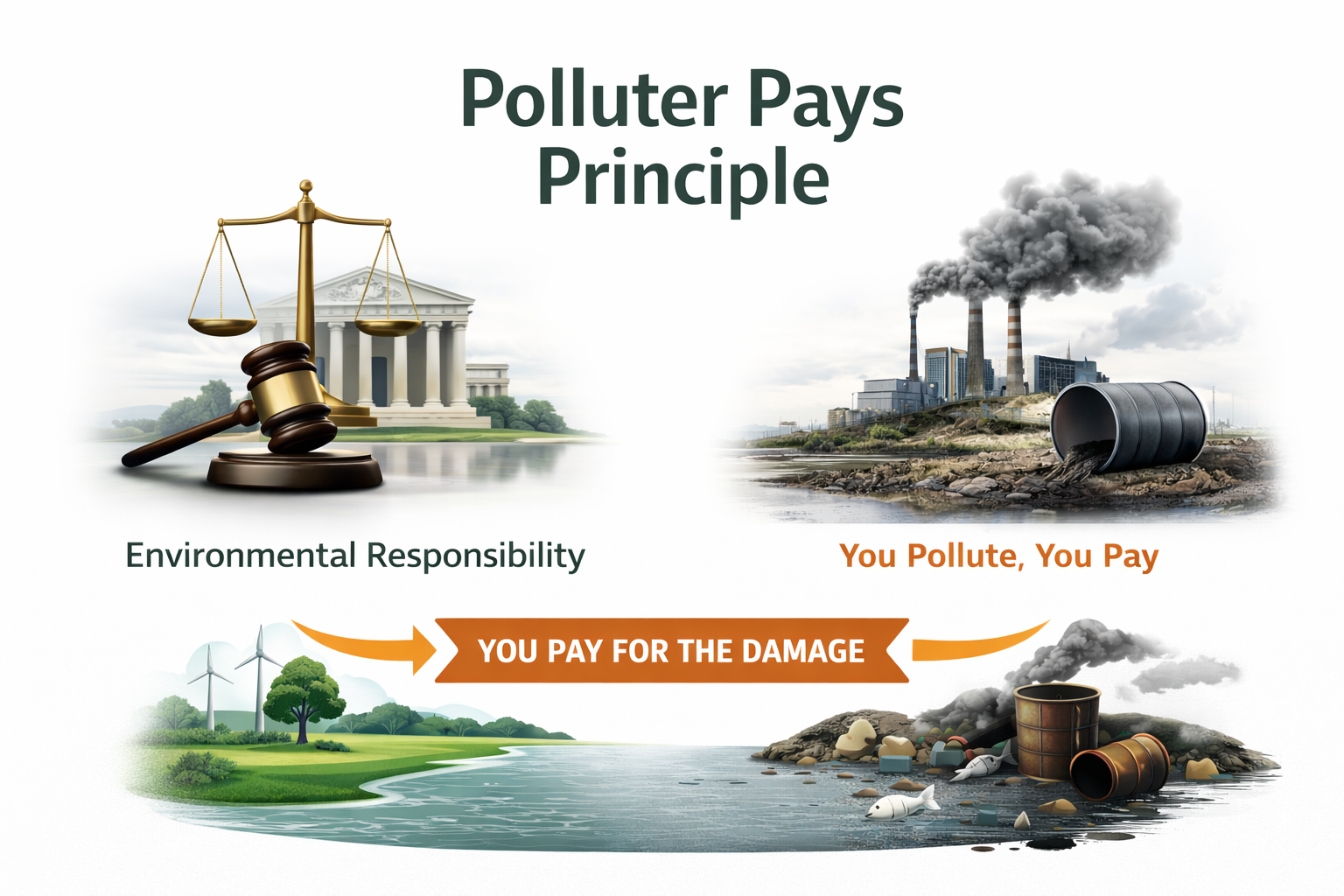
The meaning of this principle aligns well with the proverb, “You reap what you sow.” In fact, in Hindi, we have the phrase: “jaisi karni, vaisi bharni.”
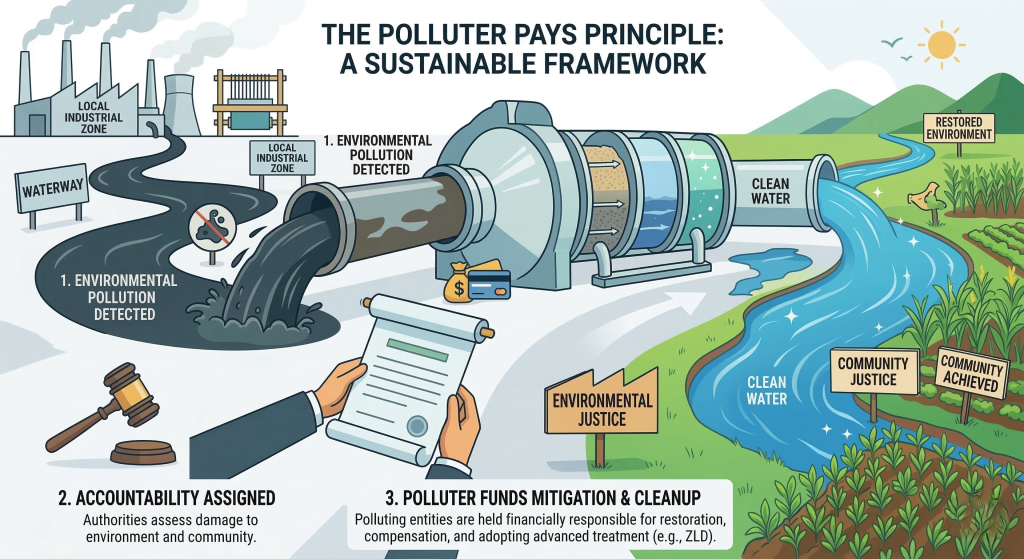
The Polluter Pays Principle is, in fact, a very straightforward concept. It simply means that the ones who make a mess have to clean it up. The Polluter Pays Principle is a tool for ensuring that those who are responsible for the pollution are the ones who bear the consequences. The incident of Bhopal made people very aware of this principle. The Polluter Pays Principle is now the standard globally.
The Polluter Pays Principle is not limited to any specific type of pollution. For example, it could be the spilling of oil or chemicals, or releasing or contaminating water or air. According to the Polluter Pays Principle, the polluters are responsible for paying for the environmental damage caused, remediate the situation and undertake measures that would prevent the recurrence of the incident.
The Case of Tirupur
Let me introduce you to Tirupur in Tamil Nadu, also called the T-shirt capital of India. It is the city that produces a large percentage of our garments and distributes them all over the country and the world. This place has many textile factories. In fact, there are more than 700 dyeing and bleaching units. These units require a lot of water to operate and, as a result, they produce huge amounts of toxic, heavily polluted wastewater.
According to the Water Act of 1974, any industry which uses water as a raw material has to legally treat its wastewater before discharging it into any water body or onto land. The law goes as far as setting the quality standards that the treated water must meet to guarantee that it is still safe for the environment. But what the textile industry in Tirupur did was totally contrary to that.
These factories dumped their concentrated toxic wastewater directly into the Noyyal River, a tributary of the Kaveri River. The river is a source of life, and the Noyyal is regarded as a holy river by the people. Thousands of people who lived on the river’s banks were dependent on it for their drinking water and irrigation needs. That river, which had nourished life, now got polluted with heavy metals such as lead, arsenic, and mercury, besides poisonous chemicals, colourants, organic substances, and cumbersome sludge. Even the water got blackened.
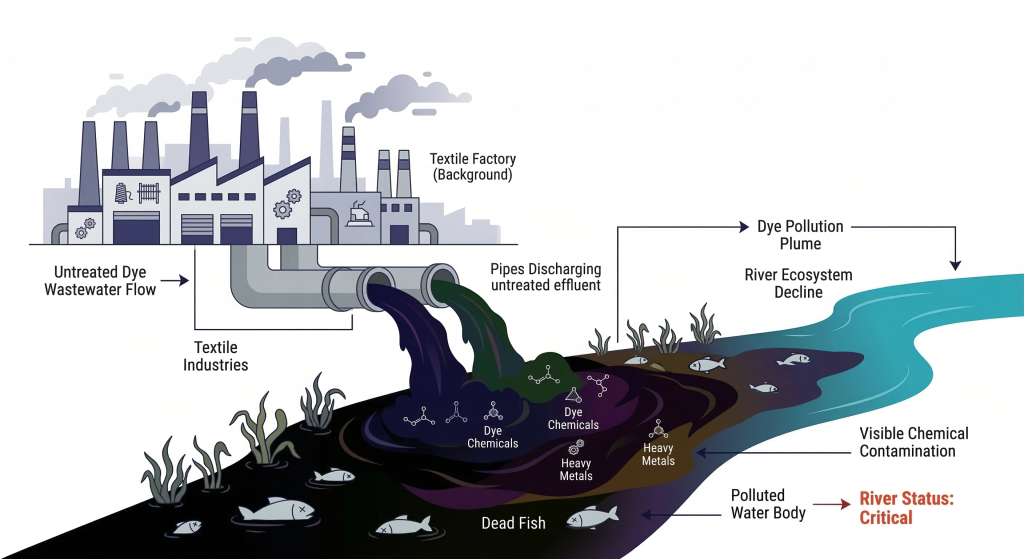
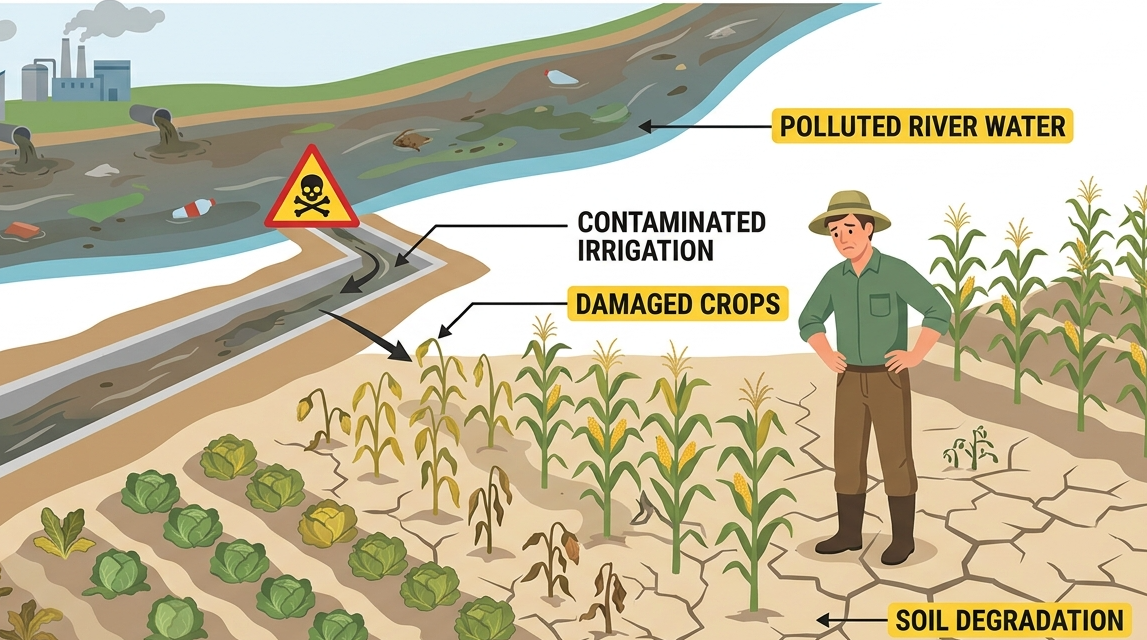
The harm was not only to humans, as animals started dying, and fish in the river were completely wiped out, which further led to an imbalance and destruction of the entire ecosystem. Also, it contaminated the groundwater and local reservoirs. In the course of irrigation, this polluted water went down to the agricultural land, making the soil less fertile as the TDS (Total Dissolved Solids) level was extremely high. This situation turned into a nightmare for the farmers who depended on that soil.
The Extension of the Harm
About 30, 000 hectares of land were polluted. 68 villages. Nearly 30, 000 Families. Besides that, crops could not be grown. The productivity drastically fell. The economic loss to the village people was very high.
The Legal Battle Begins, 1996
Frustrated and running out of options, the farmers took their matter to the Madras High Court in 1996. Luckily, their cries for justice did not fall on deaf ears. The court, in 1998, gave a very direct ruling: the textile units have to check their pollution, compensate for the harm they have caused, and take steps to clean the contaminated reservoir.
What followed? Nothing. The industry totally ignored the court order. The condition of the Noyyal River has only got worse day by day.
The Fight Goes On, 2000
Towards the end of 2000, an association took a sample of the dam’s water. The results showed that there was no change since the court order.
The farmers came back with their demands: completely clean the river, stop dumping the waste into it and hold the polluters responsible.
The factory owners, this time, were the ones who started blaming. They said that so far, they have set up 17 Common Effluent Treatment Plants (CETPs), and the Reverse Osmosis plants to achieve Zero Liquid Discharge (ZLD) are being planned. The factories stated that when all the work is finished, 100% of the wastewater will be treated before being released and will comply with the set standards.
The Court Demands Facts
The High Court, after understanding that the data was necessary to make a properly informed judgment, formed three expert committees. One of the committees was a water testing committee, which was required to travel to all the impacted areas, do water and soil quality testing, and work out the ground-level damage. The rest was an inspection committee which was supposed to go to every effluent treatment plant, observe and measure their operations, and subsequently work out the suitable fines.
Findings of the committees resulted in the following figures:
Compensation to farmers: Approximately Rs. 25 crores, for more than 8 years of misery.
Penalty for factories: Several hundred crores in fines, cleanup costs, and treatment infrastructure.
The Factory Owners Resist 2009
The factory owners, scared of these figures, filed a petition in the Supreme Court of India in 2009, stating that these numbers were extremely high and not backed by facts. The Supreme Court did its own deep investigation by putting together an inspection team to assess independently every aspect of the situation.
The Judgement
Next, the court gave its decision.
Victims who were farmers would be given around Rs. 25 crores, and the court acknowledged their sufferings on a grand scale, officially.
Factories were exposed to a financial burden of more than Rs. 800 crores.
Besides ordering them to implement the Zero Liquid Discharge system, factories were directed to clean up the environmental damage, or they would be closed permanently.
The decision sent a strong message which shone far beyond Tirupur: one cannot expect economic growth when the environment is destroyed.
The Polluter Pays Principle is the law of the land.
Thirteen Years. One River. One Fight.From 1996 to 2009, thirteen years.
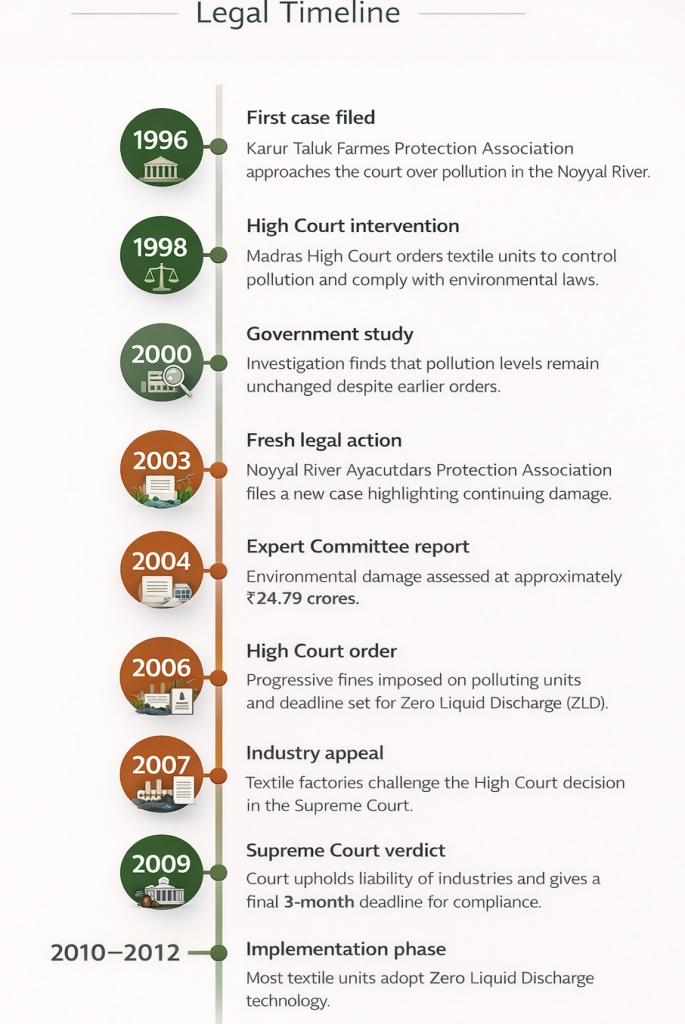
Farmers did not surrender. Judges did not surrender. There was a delay in the delivery of justice, but it was not denied.
Speaking about the Noyyal River, has it turned blue again? Are the farmers given their compensation? Do the factories have ZLD? This is a different story, namely of implementation, supervision and follow-up.
However, 2009, the day the Supreme Court ordered, was the day the battle for justice was won.
Leave a Reply