Category: Business

  • The Truth Behind Clothing Labels: Explaining EPD in Fashion

    The Truth Behind Clothing Labels: Explaining EPD in Fashion

    Usually, you might spot-check the nutrition facts before buying cereal. Perhaps you may refer to the ‘energy’ ratings before purchasing a refrigerator. An EPD (Environmental Product Declaration) is quite a bit like a nutrition label for an item of clothing, although rather than calories and sugar, it highlights the health of the planet.

    What Is an EPD?

    An Environmental Product Declaration (EPD) tells you in detail how much water was consumed, how much CO2 was emitted, and which chemicals were used when producing that particular shirt or pair of shoes.

    Fashion brands were, for a long time, able to claim that they were “green” without any evidence. Nowadays, these report cards are based on solid data that has been verified by third parties, so it is not possible to cover up “dirty” supply chains.

    A single EPD rests upon a Life Cycle Assessment. This method measures inputs and outputs across all phases. Resources are pulled in waste released, and each step gets counted. From start to finish, nothing stays hidden. Each phase reports what it takes, what it leaves behind.

    Why This Matters?

    The Hidden Cost of Fast Fashion

    The fashion industry is behind:

    • 10% of global carbon emissions (more than aviation and shipping combined)
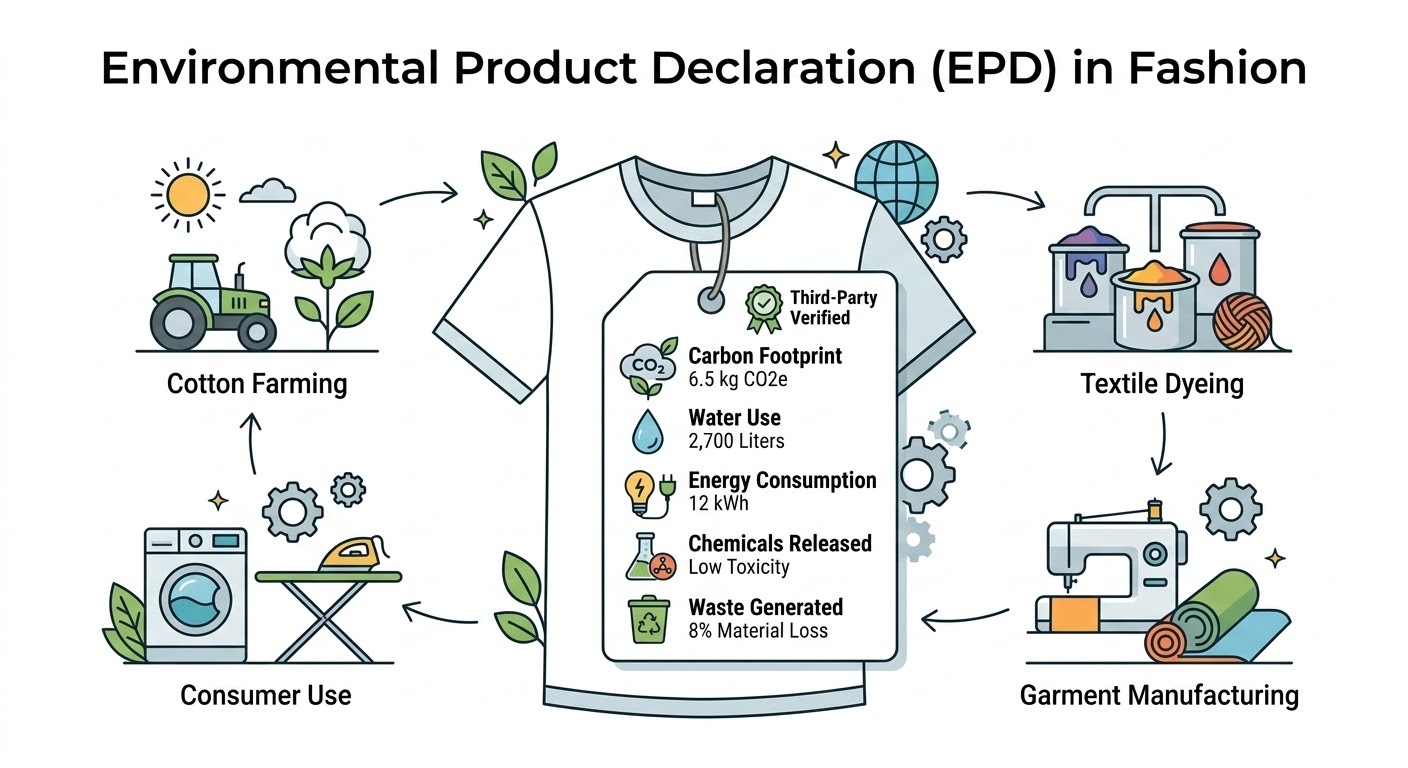
    • 20% of global wastewater (a single cotton t-shirt = 2, 700 liters of water)
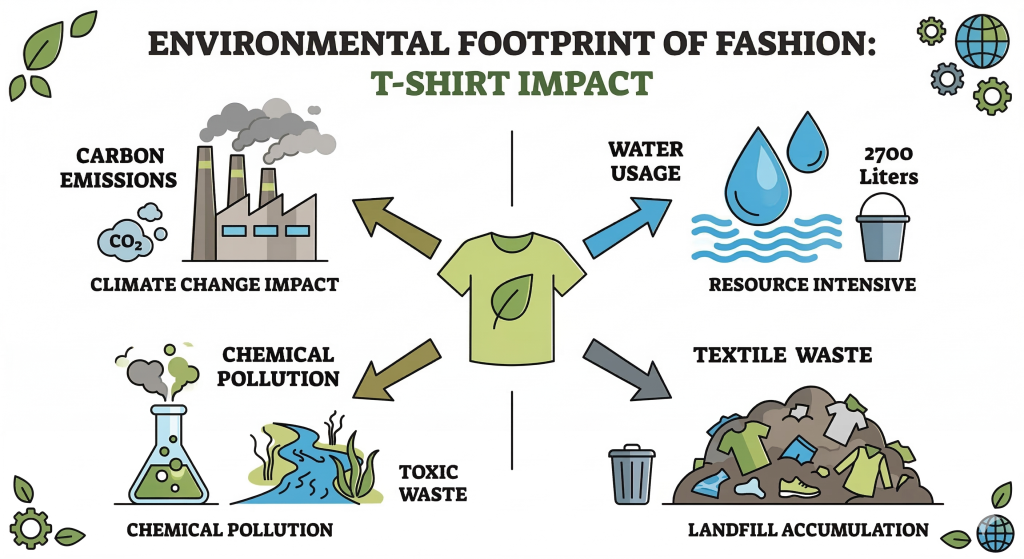
    environmental footprint of fashion, representing carbon emissions, water usage, chemical pollution, and textile waste.

    When you don’t know what the environmental impact of your clothes is, you can’t choose wisely. EPDs are a step in the right direction.

    Greenwashing Ends, Real Transparency Begins

    We have all noticed those labels: “Made with sustainable materials” or “Eco-conscious collection. However, what do they actually signify? In many cases, nothing significant. 

    EPD documents play a significant role in eliminating marketing exaggeration and reveal the following data:

    • Standardized measurements you can compare across brands
    • Verified data from the entire production lifecycle
    • Clear numbers instead of vague promises

    Below are four areas where EPD is making a difference in the fashion industry:

    1. Motivating Companies to Take Environmental Steps

    Once environmental footprints become transparent, apparel makers will start taking steps to minimize them. Nobody would want to have a very low score in terms of disclosure of information. 

    2. Encouraging the Development of New Products

    Businesses are orienting their operations towards more sustainable methods for dyes, energy, water, and materials usage because EPDs enable them to both measure and advertise enhancements.  Businesses can fairly compare two similar items, like two different cotton T-shirts, to see which has a lower footprint.

    3. Abiding by Rules and Standards.

    In fact, disclosing one’s environmental performance is turning into a requirement in a large part of the world, including the EU. Apart from making sure that brands comply with these regulations, EPDs can be a powerful tool for gaining trust and authenticity in the eyes of consumers.

    Real-World Impact

    Picture yourself browsing online, then spotting a side-by-side like this

    Brand A – Jeans emit 30 kg CO2 = Use 3,500 Liters of water = Use 40kWh energy
    Brand B – Jeans emit 15 kg CO2 = Use 1,600 liters of water = Use 20 kWh energy
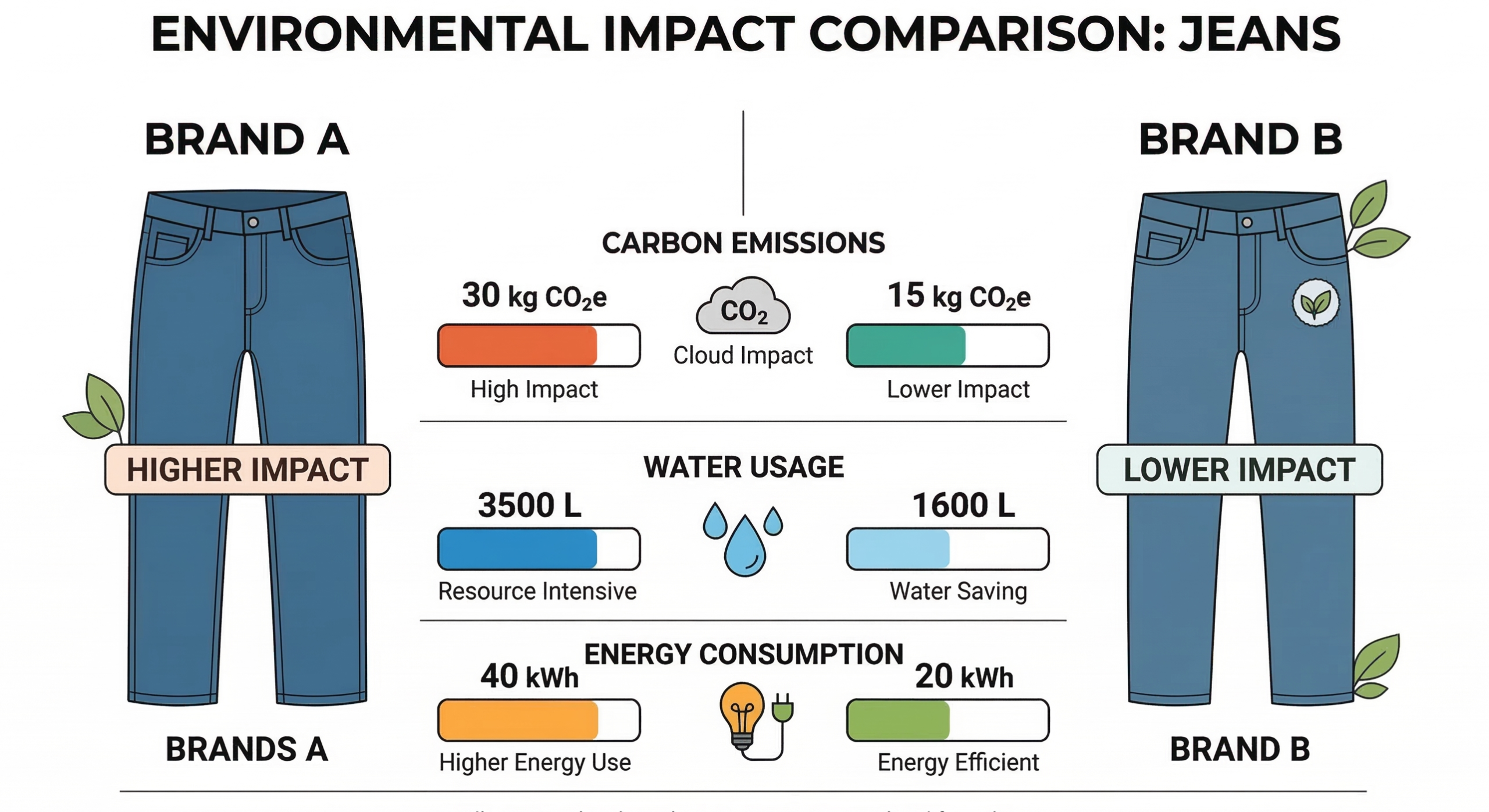
    comparison of two clothing products showing environmental data. Two jeans displayed side by side with environmental metrics

    Somewhere in the quiet, green steps become real – yours to take today.

    A few clever companies have started sharing their progress through EPDs. These updates reveal real changes they’ve made over time. Not every brand does this yet, but it’s becoming more common. What stands out is how openly they present the details. Slowly, others may follow simply by seeing what’s possible

    The Bottom Line

    EPDs are not the solution to all environmental problems; they are complicated, expensive, and not very well-known in terms of fashion yet. But they symbolize one very important thing: responsibility.

    EPDs are a sort of reality check in an industry that is mostly led by trends and looks.

    Besides style, there is always a hidden story of water energy, chemicals, and carbon behind each piece of clothing.

    In fact, you might simply decide not to buy anything or to buy the least harmful alternative after getting enough information.

    Fashion can be green, but first, we have to realize the actual price. This is why EPD is a solution.
  • Return Fraud: The Growing Problem in E-Commerce

    Return Fraud: The Growing Problem in E-Commerce

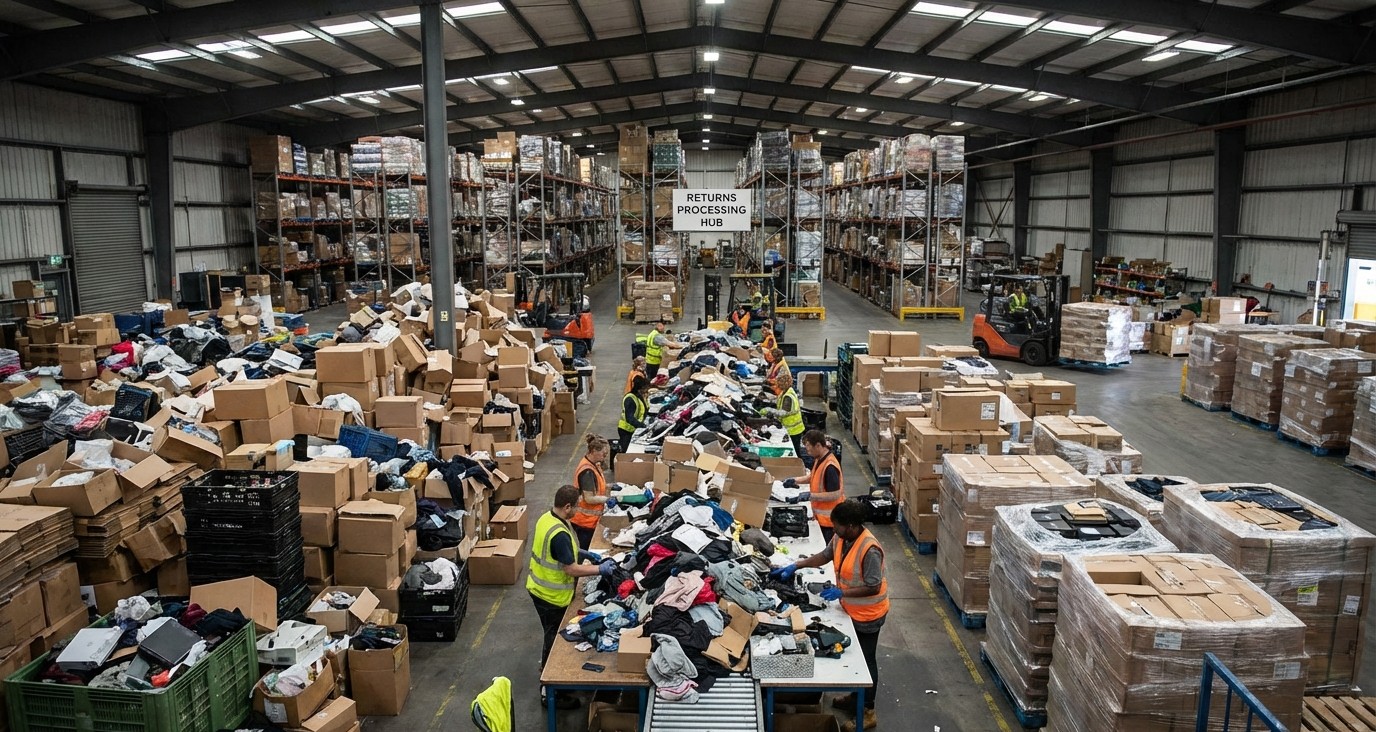
    You buy a kurta set on Myntra. Wear it to that wedding. Tags still on, carefully tucked away. Take your photos for Instagram. Return it three days later. Free rental, right? Except Myntra can’t resell it now. So it gets tossed. Or shipped to some liquidation warehouse. Or worse. This is return fraud. And in India, it’s not just destroying retailers’ profits. It’s creating mountains of waste.

    The Numbers in India Are Wild

    India’s e-commerce return rate sits between 25-40% during festive seasons. That’s one in three orders coming back.

    In 2024, return fraud cost Indian e-commerce platforms billions. Myntra alone lost ₹50 crore nationwide to refund scams. Meesho got hit for ₹5.5 crore by just three fraudsters in Gujarat.

    All that merchandise? Either destroyed or dumped.

    What Counts as Return Fraud Here?

    Wardrobing is massive in India. Many customers buy clothes in multiple sizes just to try them on and return the rest. Not “maybe” return. Plan to return.

    Cash on Delivery (COD) fraud. People order stuff, don’t have cash when it arrives, and refuse delivery. The product goes back. Cash on Delivery orders consistently show higher return rates than prepaid purchases. Research indicates that around 40% of COD orders are returned, compared to an overall average of 20% across online retail. In simple terms, nearly two out of five COD shipments never make it past the customer’s doorstep.

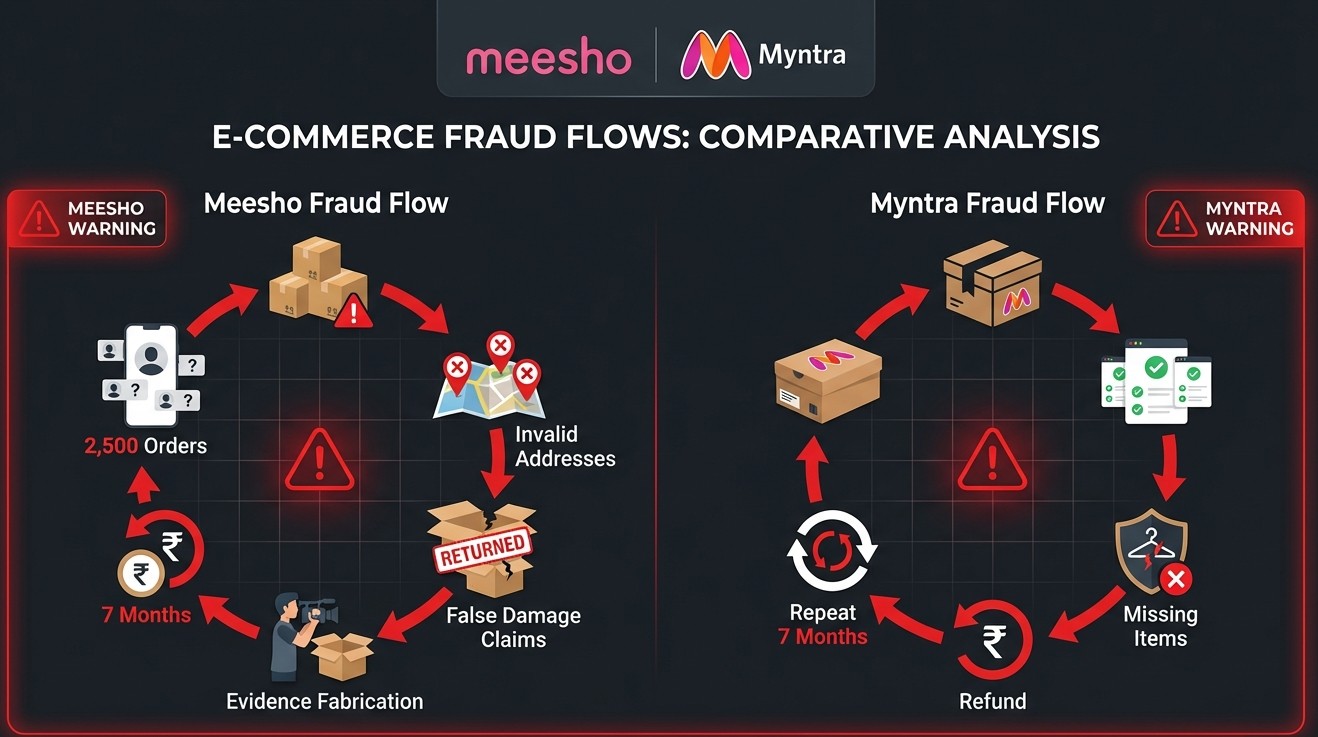
    Then there’s refund fraud. The Meesho case? Three guys created fake buyer accounts and placed around 2,500 orders using invalid addresses, causing all shipments to be returned. They then filmed opened parcels and falsely claimed the items were damaged to secure reimbursements. The scheme ran for seven months.

    Return Abuse in Fashion E-commerce meesho and myntra case

    The Myntra gang ordered branded shoes and claimed they received fewer items than ordered. Filed 5,529 fraudulent orders in Bengaluru alone.

    Why Indian Retailers Throw Stuff Away

    According to a report by the National Retail Federation (NRF), about 9% of all returns are fraudulent. Retailers tracking these cases say almost 70% have seen a rise in customers overstating the number of items they’re returning. Many also report more empty-box scams and cases where genuine products are swapped with counterfeit or decoy items.

    In India? It’s worse.

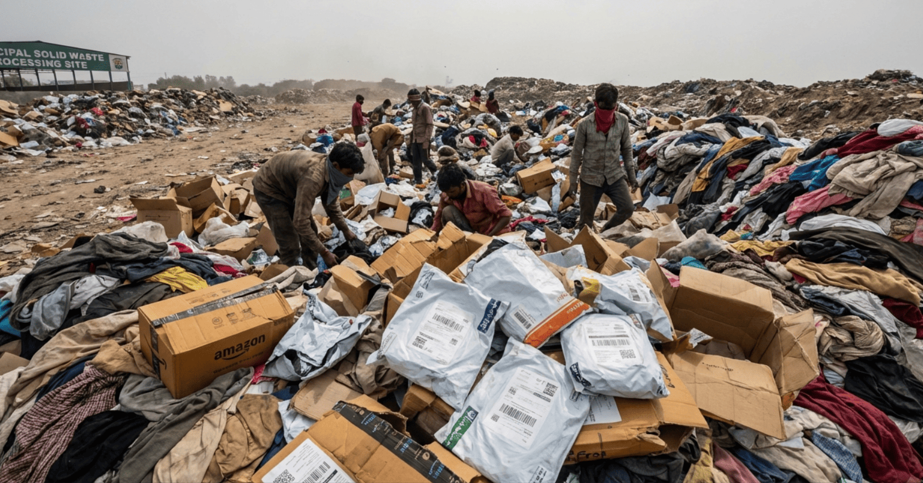
    Landfill Site in India with Discarded Clothing and Packaging Waste

    Small D2C brands struggle to track returns. They lack reverse logistics infrastructure. So when a product returns from a tier-2 or tier-3 city, the expense of shipping it to a warehouse, checking its quality, repackaging it and then relisting it becomes more than the item is worth.

    Cheaper to dump it.

    Damaged products or products claimed to be damaged can’t be resold. They go straight to landfills.

    India’s reverse logistics market is growing rapidly, driven by the increasing number of e-commerce returns. But growth has not entirely addressed the capacity gap. Infrastructure, sorting systems and refurbishment networks are not yet keeping pace with the demand. As a result, many of those returned products never find their way back into resale or recycling channels. Instead, they depreciate rapidly and far too frequently, and end up as trash.

    The Environmental Toll Is Brutal

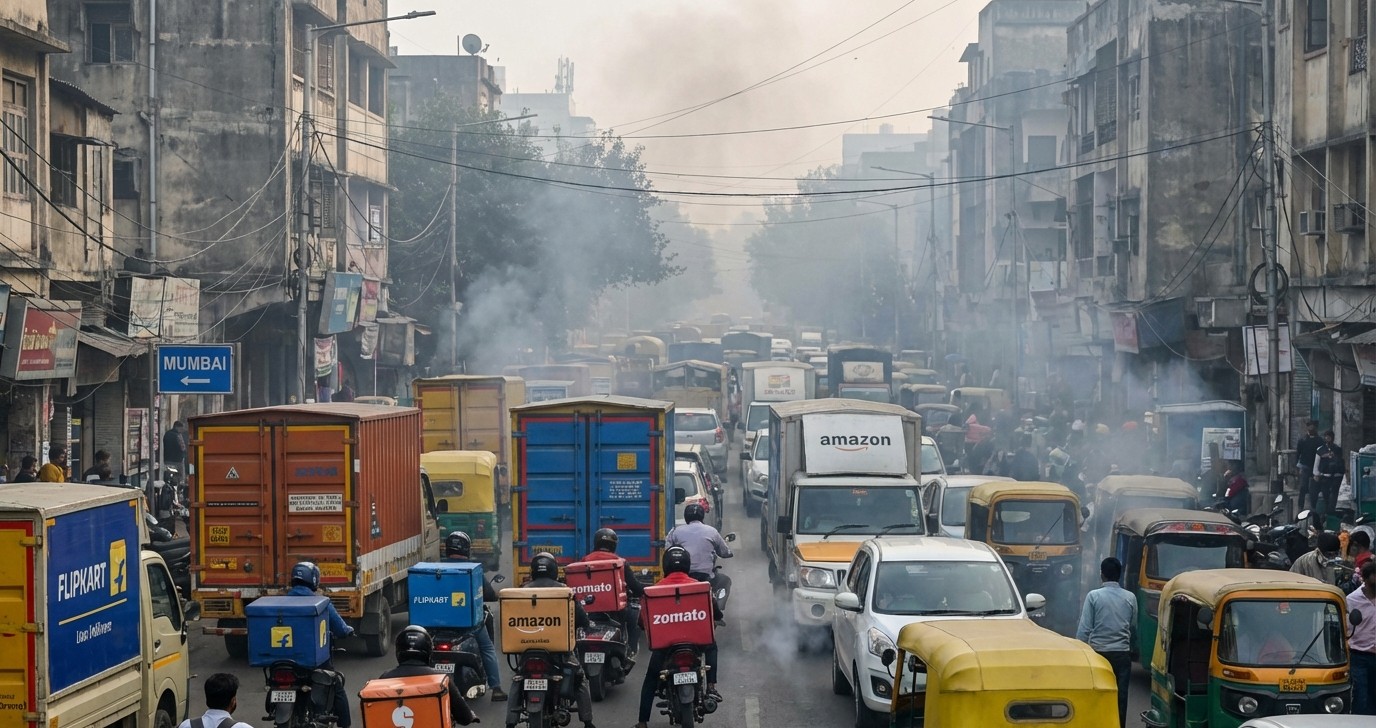
    Every return creates emissions. The delivery guy picks it up. A truck moves it to a sorting centre. Another truck to a warehouse. Maybe another to liquidation.

    In India, where logistics networks are less efficient than those in developed countries, there’s a lot of carbon emitted going back and forth like this. Broken goods in the landfill? They pollute soil and water. Waste from packaging returns such as bubble wrap, cardboard, and plastic tape, piles up quickly.

    Heavy Indian City Traffic with Delivery Vehicles

    Both fashion return rates and size spikes up drastically during major festive sales like Big Billion Days or Great Indian Festival. That can mean millions of items all move back through the supply chain at once, and a large portion never make it as far as inventory. Instead, a majority of them land in liquidation channels or on the way to disposal.

    And nobody’s tracking it. The environmental cost of returns isn’t part of anyone’s reporting.

    Why This Keeps Getting Worse in India

    Free returns. That’s the core.

    Flipkart, Amazon and Myntra all offer 10-30 day no-questions-asked return policies to compete. 92% of Indian shoppers specifically look for easy and free returns before buying.

    Social media made it worse here, too. Instagram reels and YouTube hauls normalise buying stuff just to show it off and send it back.

    Cash on Delivery is another factor. Nearly half of India’s e-commerce transactions are COD. It’s convenient, but creates massive RTO rates when people change their minds or don’t have cash.

    Youtube, instagram , facebook product haul

    Nearly 26% COD orders come back, compared to less than 2% for prepaid orders. In practical terms, that makes COD returns more than ten times higher than prepaid returns.

    And there’s size/fit uncertainty. Standardised sizing doesn’t work. So people buy multiple sizes because they know at least two won’t fit. Free returns enable this behaviour.

    Indian Platforms Are Fighting Back

    Flipkart launched an AI tool called “Mira” to reduce its return rate by asking shoppers a few questions before purchase to prevent size/fit issues.

    Myntra uses “Sabre,” an AI that analyses past return patterns to detect fraud. It can tell the difference between genuine returns and serial returners gaming the system.

    They’ve also started:

    • Blocking COD for customers with high return rates
    • Charging return fees after a certain point
    • Restricting refunds for repeat offenders
    • Flagging customers who return excessively

    But there’s a problem. 55% of Indian consumers avoid buying if return policies are too strict.

    So platforms are stuck. Tighten policies, lose customers. Keep them loose, lose money and create waste.

    What Actually Happens to Returns in India

    Best case? The item gets inspected at a return centre in Mumbai or Bengaluru, repackaged, and re-listed.

    But that’s rare.

    More often, returns get:

    • Sold to liquidators at a steep discount, recovering only a small portion of their original price.
    • Donated (if in decent condition and someone bothers)
    • Sent to tier-2/3 city markets in bulk
    • Destroyed

    Indian e-commerce companies don’t publicly share how much they destroy. But based on global averages (25% of returns destroyed), and India’s higher return rates plus weaker

    reverse logistics, the destruction rate here is likely higher. Some of it ends up in Panipat’s textile recycling market. But most? Landfills.

    The Real Cost

    Return fraud costs Indian e-commerce thousands of crores. But that’s just money. 
    Water. Energy. Carbon. Chemicals. Labor. All wasted because someone wanted it for one night.

    And most people are wardrobing or doing COD fraud? They don’t see it as fraud. They see it as smart shopping.

    It’s normalised. Expected. Part of the game.

    But someone’s paying. And it’s not just Flipkart.

  • Turn your designs into income with TeeEvo.

    Your Art, Your Empire: The Ultimate Guide to Print-on-Demand with TeeEvo

    You may already have designs saved on your computer, sketches in a notebook, or an Instagram page where people comment, “I’d buy this on a shirt.”
    If you’ve ever thought about turning your creative ideas into real products, this guide shows you exactly how.

    With print-on-demand, creators can sell custom products online without inventory, upfront costs, or risk, and TeeEvo is built to make that process simple, transparent, and creator-first.

    Why Print-on-Demand Is Growing Fast

    The creator economy and demand for personalized products continue to rise. Consumers want meaningful, custom items, and creators want business models that don’t require heavy investment.

    • The global print-on-demand market was valued at nearly USD 10 billion in 2024
    • Growth is driven by e-commerce, personalization, and sustainable production
    • Small brands and independent creators are leading this shift

    Print-on-demand fits perfectly into how people shop today.

    exponential growth of pod business

    Where TeeEvo Fits In

    TeeEvo is more than a print-on-demand service. It acts as your production partner, fulfilment team, and digital storefront, all in one platform.

    TeeEvo is built for:

    • Independent creators and artists
    • Designers building clothing brands
    • Local print shops moving online

    Everything is designed to help you turn creative ideas into sellable products without technical friction.

    How to start selling on TeeEvo (Step-by-Step)

    Step 1: Choose a profitable Print-on-Demand niche

    Successful POD brands don’t design for everyone. They design for specific, passionate audiences.

    High-demand niches include:

    • Anime and pop culture designs
    • Artistic and expressive illustrations
    • Music, band, and lyric-based graphics
    • Automotive culture (cars, bikes, motorsports)
    • Clean typography and quote-based apparel
    sustainable pod india
Oversized black organic cotton t-shirt with a minimalist white typography design on a male model. High-quality sustainable streetwear India.

    Ask yourself:

    • What niche am I already part of?
    • What designs are popular but poorly executed?
    • What would I actually buy?

    Finding this overlap gives you a competitive edge.

    Step 2: Design With Real-Time Pricing Transparency

    One of the biggest challenges in print-on-demand is unexpected production costs.

    TeeEvo solves this with real-time pricing visibility:

    • Larger print areas = higher cost
    • Smaller, minimalist designs = lower cost
    • You see your margins while designing, not after

    This helps you design smarter and price confidently.

    oversized-streetwear-tshirt-design-india

premium-organic-cotton-tshirt-lifestyle-shot

custom-printed-black-tee-male-model-street-style

unisex-graphic-tshirt-sustainable-fashion-brand

high-quality-dtg-print-on-white-cotton-tee
ai-tshirt-design-tool-interface-dashboard

text-to-design-ai-generator-for-apparel

custom-tshirt-creator-online-no-design-skills

real-time-pricing-calculator-for-custom-clothing

digital-mockup-generator-for-streetwear-creators

    A Safer Way to Start

    Lower Risk for Beginners

    You can start with smaller designs, order low-cost samples, and test quality before scaling—making TeeEvo ideal for first-time POD sellers.

    Step 3: Create Your Online Store

    Setting up a TeeEvo store is simple, beginner-friendly, and completely free.

    You can:

    • Create a free storefront
    • Upload designs
    • Choose fabrics and branding options
    • Preview realistic product mockups

    You control pricing, branding, and presentation, without hidden fees.

    Step 4: Upload, Price, and Finalize Products

    Before launch:

    • Review how designs look on different products
    • Set pricing based on quality and target audience
    • Decide whether to offer introductory discounts

    These decisions shape how customers perceive your brand and value.

    Step 5: Launch and Promote Your Products

    Promotion connects your designs to buyers.

    Print on demand India, Start a clothing brand India, Custom t-shirt printing online, Sustainable streetwear India
Dropshipping apparel India, No inventory business ideas, Direct to garment printing service, Passive income for artists
Create a free online store, Best POD platform for creators, Design your own t-shirt

    Best platforms for print-on-demand marketing:

    • Instagram and Instagram shops
    • Facebook business pages
    • WhatsApp communities
    • Telegram channels

    And as you grow, you won’t have to promote alone.

    With TeeEvo Business, we will offer structured growth support for scaling brands, including bulk campaign support, branded merchandise solutions, advanced performance insights, and priority fulfilment for high-volume sellers.

    So whether you’re testing your first design or launching a full merchandise line, the infrastructure grows with you.

    Focus on storytelling. Share what inspired the design, who it’s for, and why it matters. Emotional connection drives conversions.

    Why Print-on-Demand Helps You Build a Smarter Business

    Print-on-demand (POD) works because it follows one simple rule: make products only after someone buys them.
    That single shift removes a lot of risk and waste, which is why POD continues to grow as a business model for creators and sellers.

    Start Selling Without Risk or Upfront Costs

    Print-on-demand lets you launch without guessing or overinvesting.

    • Sell without buying inventory first
    • Avoid bulk orders and storage costs
    • Test designs with real buyers
    • Grow only when orders come in

    This makes POD an easy entry point for designers, print shops, and first-time sellers who want to start small and stay flexible.

    Reduce Waste by Producing Only What Sells

    Overproduction is one of the biggest problems in fashion.

    Today:

    • Fashion creates 8–10%of global carbon emissions
    • Nearly 30% of clothing is never sold
    • Unsold items often end up dumped or destroyed
    • Nearly 20% of global wastewater comes from textile dyeing.
    Custom T-shirt Printing, Zero-waste Fashion, Side Hustle for Designers, No-inventory Business

    Print-on-demand prevents this by producing items only when they’re ordered. No excess stock. No leftovers. Less waste from the start.

    Meet Customer Demand for Responsible, Made-to-Order Products

    People care more about how products are made.

    • Around 70% of consumers prefer brands that act responsibly
    • Buyers increasingly avoid mass-produced, disposable products

    Print-on-demand gives customers something different. Their product isn’t made in bulk or stored for months. It’s created specifically for them, which builds trust and repeat business.

    A Note on Our Values: The Green Commitment

    We believe in providing a service that satisfies you and the environment.

    We want to be transparent with you: We are currently launching, and we are learning. To proudly call ourselves an environmentally conscious, sustainable POD brand is our ultimate goal. Are there hurdles? Yes. Are there gaps we need to fill? Absolutely.

    But we are super excited to bridge those gaps. By choosing TeeEvo, you aren’t just building a business; you’re joining a brand that is actively striving to do better for the planet, one print at a time.

    Why Choose TeeEvo?

    • Free print-on-demand store setup
    • Transparent, real-time pricing tools
    • High-quality printing and materials
    • Support for creators, designers, and print shops
    • A growing sustainability vision

    Ready to Start?

    If you’re still reading, curiosity has already done its job.

    The difference between creators who earn and creators who only imagine isn’t talent.
    It’s action.

    Design something.
    Upload it.
    Launch your store.
    Share it with ten people.

    Your first goal isn’t perfection.
    It’s momentum.