Blog

  • The Truth Behind Clothing Labels: Explaining EPD in Fashion

    The Truth Behind Clothing Labels: Explaining EPD in Fashion

    Usually, you might spot-check the nutrition facts before buying cereal. Perhaps you may refer to the ‘energy’ ratings before purchasing a refrigerator. An EPD (Environmental Product Declaration) is quite a bit like a nutrition label for an item of clothing, although rather than calories and sugar, it highlights the health of the planet.

    What Is an EPD?

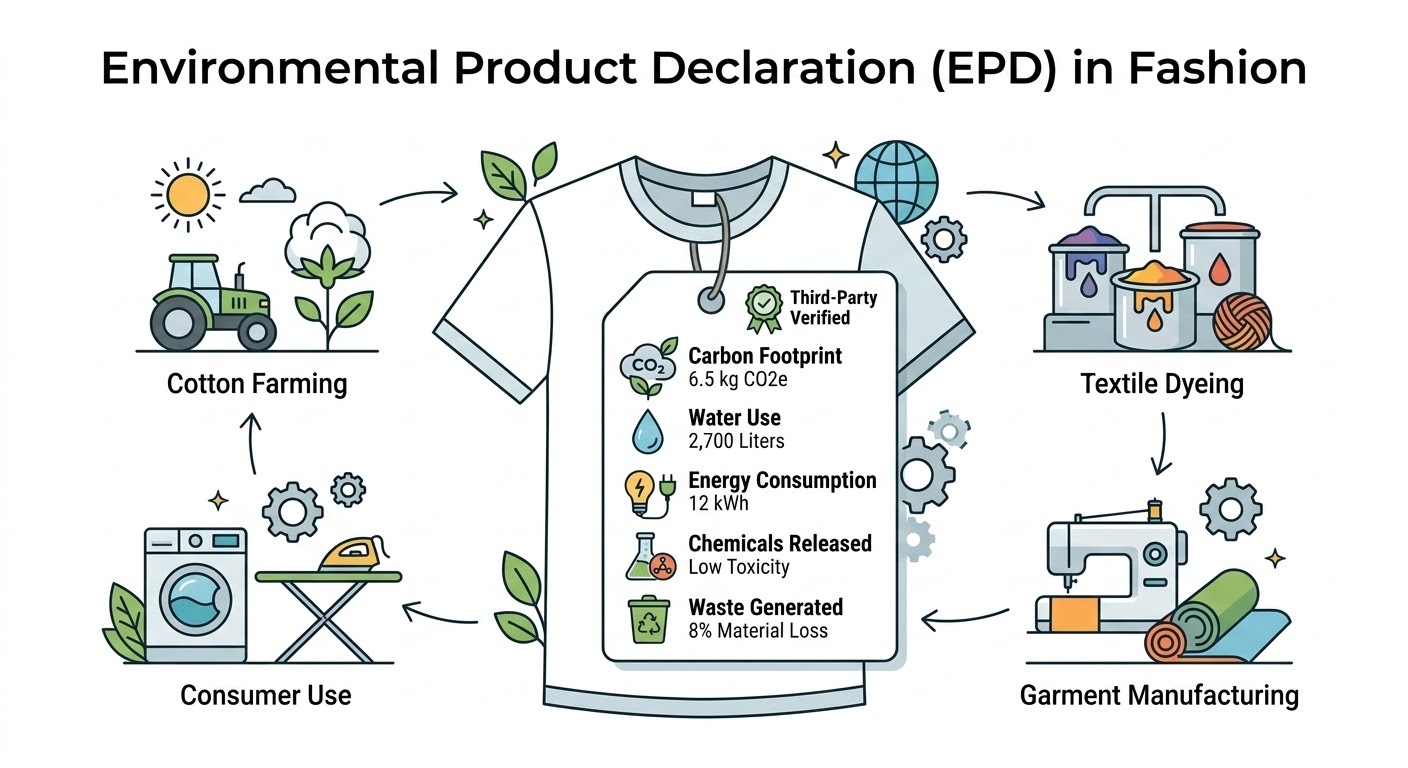
    An Environmental Product Declaration (EPD) tells you in detail how much water was consumed, how much CO2 was emitted, and which chemicals were used when producing that particular shirt or pair of shoes.

    Fashion brands were, for a long time, able to claim that they were “green” without any evidence. Nowadays, these report cards are based on solid data that has been verified by third parties, so it is not possible to cover up “dirty” supply chains.

    A single EPD rests upon a Life Cycle Assessment. This method measures inputs and outputs across all phases. Resources are pulled in waste released, and each step gets counted. From start to finish, nothing stays hidden. Each phase reports what it takes, what it leaves behind.

    Why This Matters?

    The Hidden Cost of Fast Fashion

    The fashion industry is behind:

    • 10% of global carbon emissions (more than aviation and shipping combined)
    • 20% of global wastewater (a single cotton t-shirt = 2, 700 liters of water)
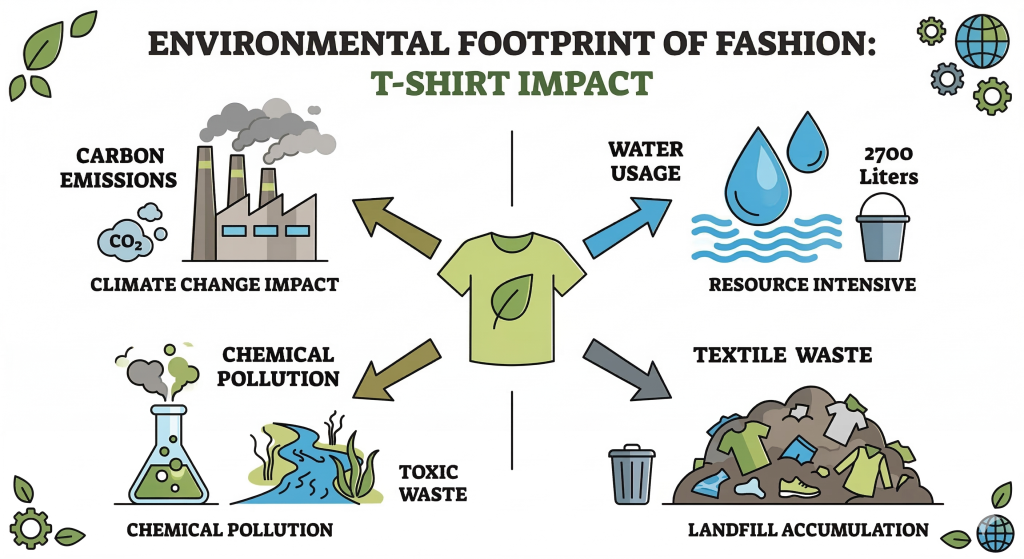
    environmental footprint of fashion, representing carbon emissions, water usage, chemical pollution, and textile waste.

    When you don’t know what the environmental impact of your clothes is, you can’t choose wisely. EPDs are a step in the right direction.

    Greenwashing Ends, Real Transparency Begins

    We have all noticed those labels: “Made with sustainable materials” or “Eco-conscious collection. However, what do they actually signify? In many cases, nothing significant. 

    EPD documents play a significant role in eliminating marketing exaggeration and reveal the following data:

    • Standardized measurements you can compare across brands
    • Verified data from the entire production lifecycle
    • Clear numbers instead of vague promises

    Below are four areas where EPD is making a difference in the fashion industry:

    1. Motivating Companies to Take Environmental Steps

    Once environmental footprints become transparent, apparel makers will start taking steps to minimize them. Nobody would want to have a very low score in terms of disclosure of information. 

    2. Encouraging the Development of New Products

    Businesses are orienting their operations towards more sustainable methods for dyes, energy, water, and materials usage because EPDs enable them to both measure and advertise enhancements.  Businesses can fairly compare two similar items, like two different cotton T-shirts, to see which has a lower footprint.

    3. Abiding by Rules and Standards.

    In fact, disclosing one’s environmental performance is turning into a requirement in a large part of the world, including the EU. Apart from making sure that brands comply with these regulations, EPDs can be a powerful tool for gaining trust and authenticity in the eyes of consumers.

    Real-World Impact

    Picture yourself browsing online, then spotting a side-by-side like this

    Brand A – Jeans emit 30 kg CO2 = Use 3,500 Liters of water = Use 40kWh energy
    Brand B – Jeans emit 15 kg CO2 = Use 1,600 liters of water = Use 20 kWh energy
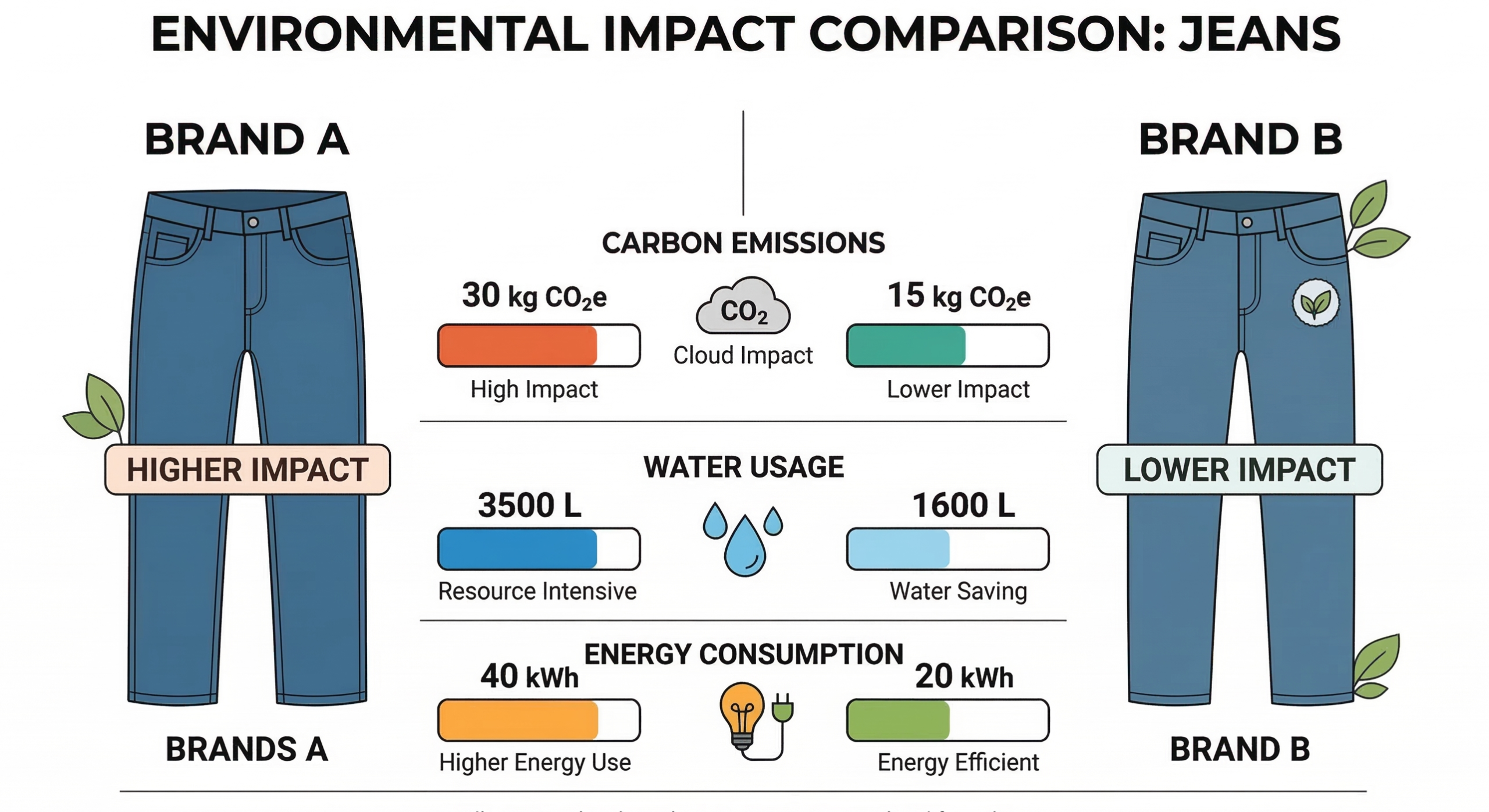
    comparison of two clothing products showing environmental data. Two jeans displayed side by side with environmental metrics

    Somewhere in the quiet, green steps become real – yours to take today.

    A few clever companies have started sharing their progress through EPDs. These updates reveal real changes they’ve made over time. Not every brand does this yet, but it’s becoming more common. What stands out is how openly they present the details. Slowly, others may follow simply by seeing what’s possible

    The Bottom Line

    EPDs are not the solution to all environmental problems; they are complicated, expensive, and not very well-known in terms of fashion yet. But they symbolize one very important thing: responsibility.

    EPDs are a sort of reality check in an industry that is mostly led by trends and looks.

    Besides style, there is always a hidden story of water energy, chemicals, and carbon behind each piece of clothing.

    In fact, you might simply decide not to buy anything or to buy the least harmful alternative after getting enough information.

    Fashion can be green, but first, we have to realize the actual price. This is why EPD is a solution.
  • The Polluter Pays Principle: Case study of Noyyal River, Tamil Nadu

    The Polluter Pays Principle: Case study of Noyyal River, Tamil Nadu

    The meaning of this principle aligns well with the proverb, “You reap what you sow.” In fact, in Hindi, we have the phrase: “jaisi karni, vaisi bharni.”

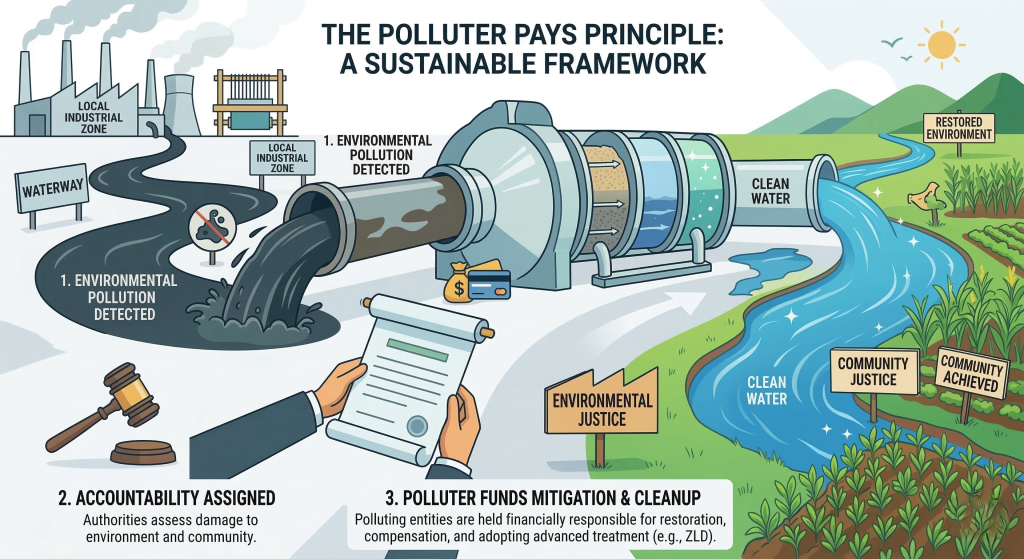
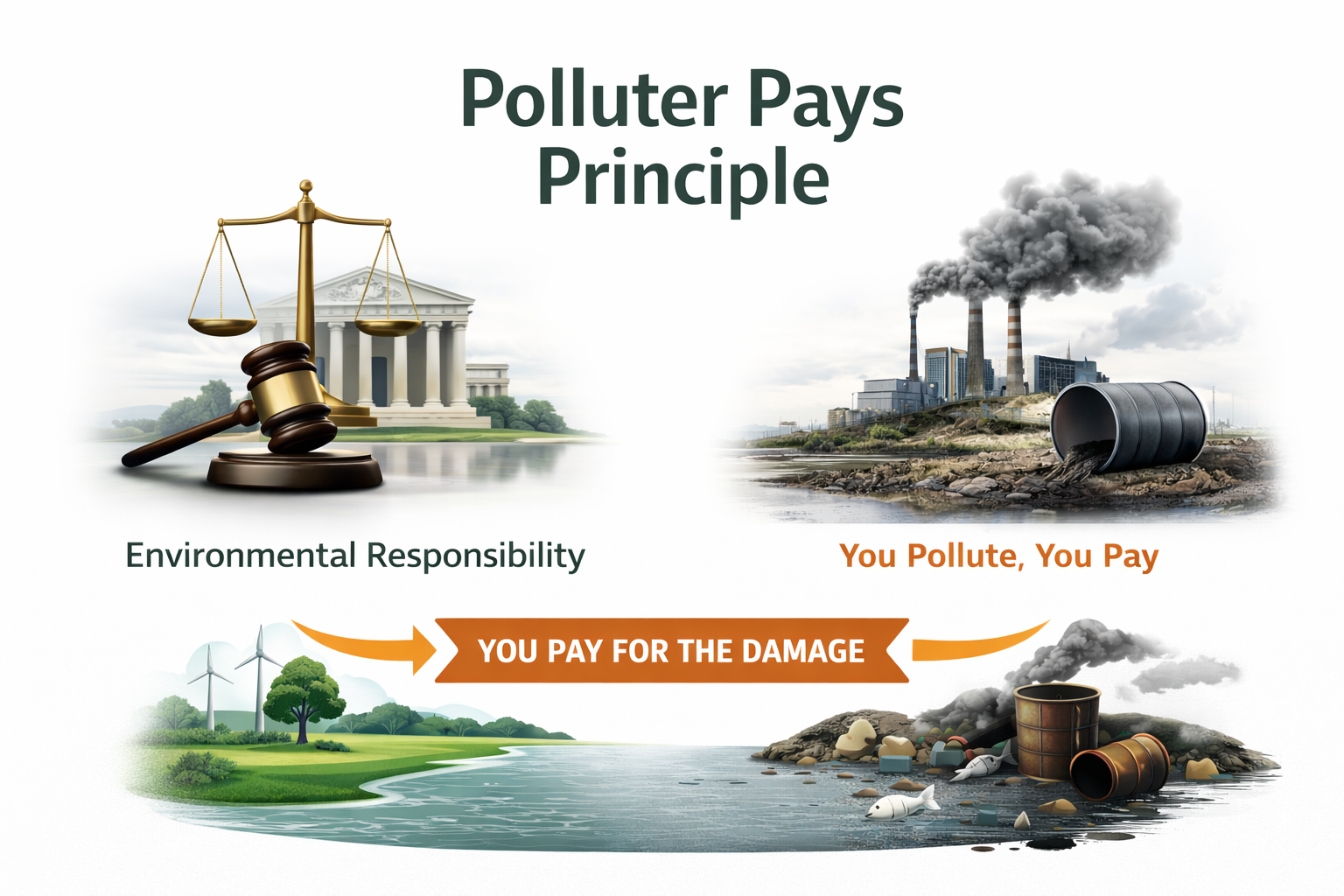
    The Polluter Pays Principle is, in fact, a very straightforward concept. It simply means that the ones who make a mess have to clean it up. The Polluter Pays Principle is a tool for ensuring that those who are responsible for the pollution are the ones who bear the consequences. The incident of Bhopal made people very aware of this principle. The Polluter Pays Principle is now the standard globally.

    The Polluter Pays Principle is not limited to any specific type of pollution. For example, it could be the spilling of oil or chemicals, or releasing or contaminating water or air. According to the Polluter Pays Principle, the polluters are responsible for paying for the environmental damage caused, remediate the situation and undertake measures that would prevent the recurrence of the incident.

    The Case of Tirupur

    Let me introduce you to Tirupur in Tamil Nadu, also called the T-shirt capital of India. It is the city that produces a large percentage of our garments and distributes them all over the country and the world. This place has many textile factories. In fact, there are more than 700 dyeing and bleaching units. These units require a lot of water to operate and, as a result, they produce huge amounts of toxic, heavily polluted wastewater. 

    According to the Water Act of 1974, any industry which uses water as a raw material has to legally treat its wastewater before discharging it into any water body or onto land. The law goes as far as setting the quality standards that the treated water must meet to guarantee that it is still safe for the environment. But what the textile industry in Tirupur did was totally contrary to that.

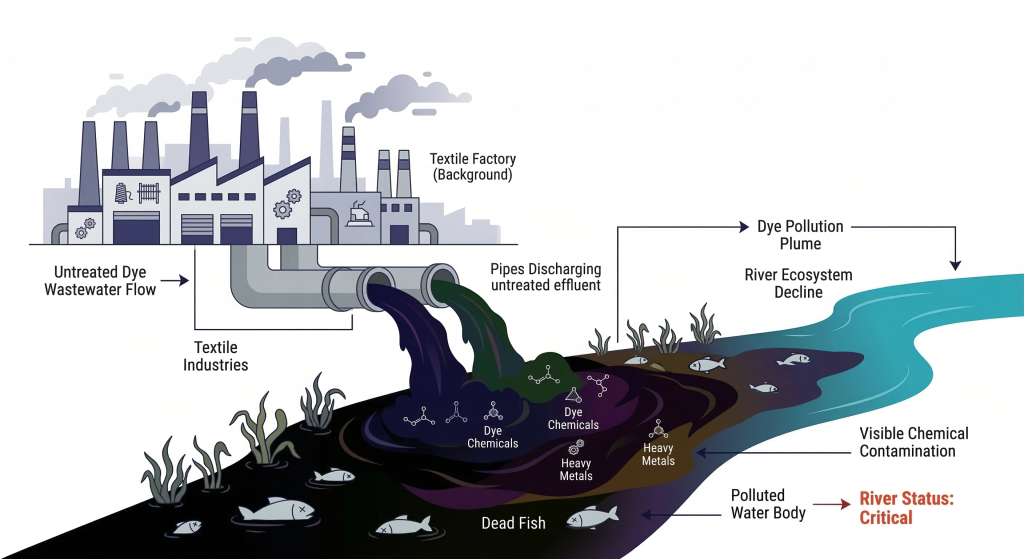
    These factories dumped their concentrated toxic wastewater directly into the Noyyal River, a tributary of the Kaveri River. The river is a source of life, and the Noyyal is regarded as a holy river by the people. Thousands of people who lived on the river’s banks were dependent on it for their drinking water and irrigation needs. That river, which had nourished life, now got polluted with heavy metals such as lead, arsenic, and mercury, besides poisonous chemicals, colourants, organic substances, and cumbersome sludge. Even the water got blackened. 

    water pollution and dying of fishes and animal due to untreated industrial effluent

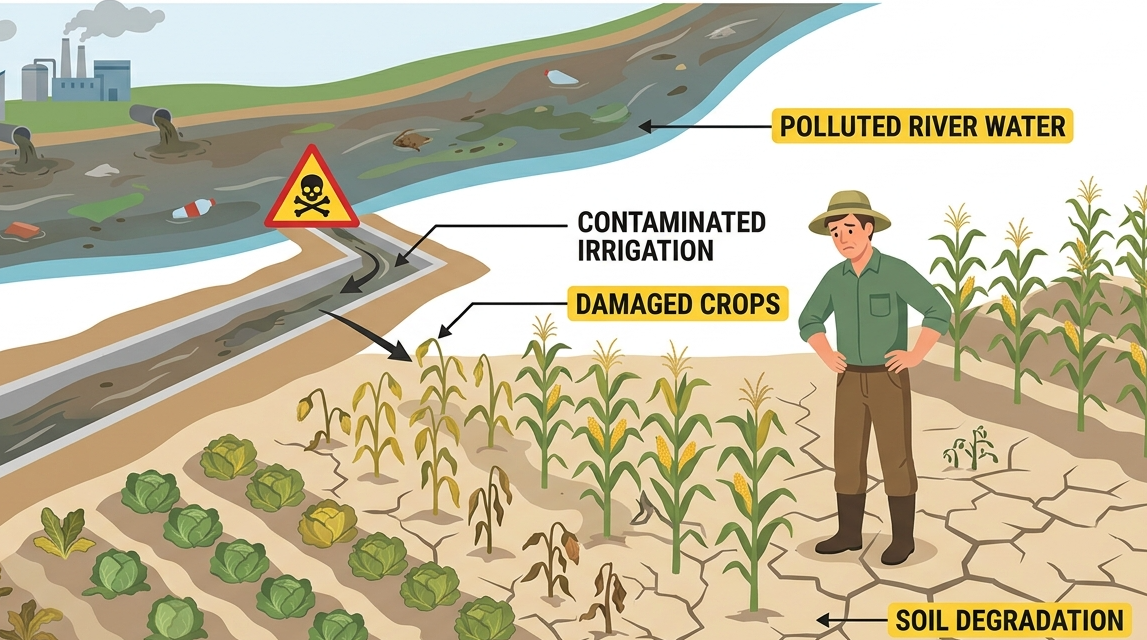
    The harm was not only to humans, as animals started dying, and fish in the river were completely wiped out, which further led to an imbalance and destruction of the entire ecosystem. Also, it contaminated the groundwater and local reservoirs. In the course of irrigation, this polluted water went down to the agricultural land, making the soil less fertile as the TDS (Total Dissolved Solids) level was extremely high. This situation turned into a nightmare for the farmers who depended on that soil. 

    The Extension of the Harm 

    About 30, 000 hectares of land were polluted. 68 villages. Nearly 30, 000 Families. Besides that, crops could not be grown. The productivity drastically fell. The economic loss to the village people was very high.

    Polluted river water entering agricultural fields. dark contaminated irrigation water flows from the polluted river into the farmland through irrigation channels.

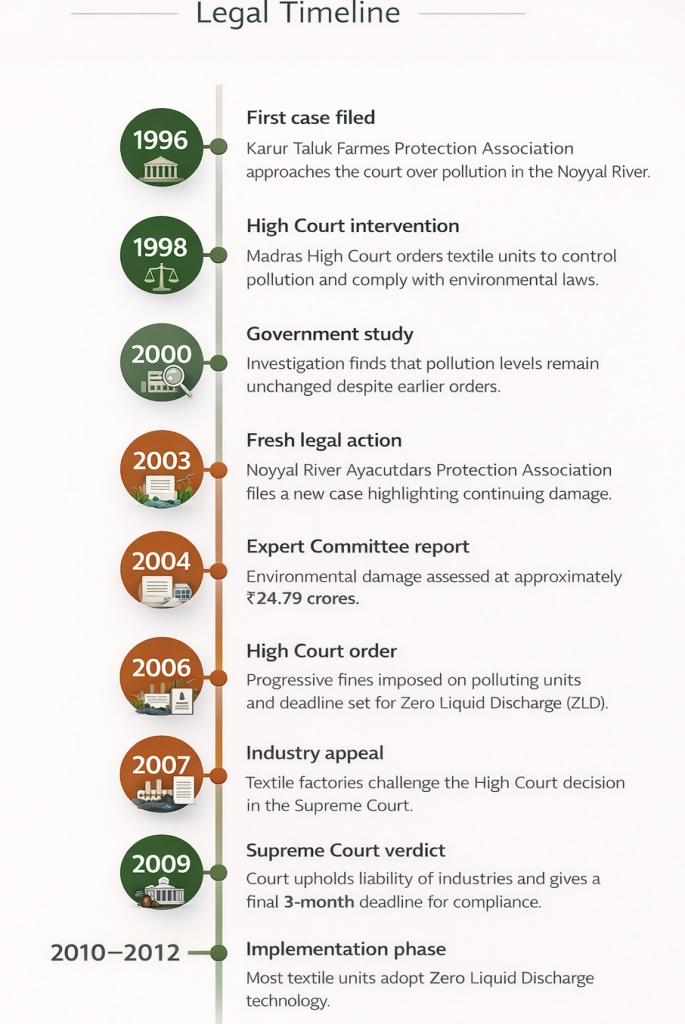
    The Legal Battle Begins, 1996 

    Frustrated and running out of options, the farmers took their matter to the Madras High Court in 1996. Luckily, their cries for justice did not fall on deaf ears. The court, in 1998, gave a very direct ruling: the textile units have to check their pollution, compensate for the harm they have caused, and take steps to clean the contaminated reservoir. 

    What followed? Nothing. The industry totally ignored the court order. The condition of the Noyyal River has only got worse day by day. 

    The Fight Goes On, 2000 

    Towards the end of 2000, an association took a sample of the dam’s water. The results showed that there was no change since the court order. 

    The farmers came back with their demands: completely clean the river, stop dumping the waste into it and hold the polluters responsible. 

    The factory owners, this time, were the ones who started blaming. They said that so far, they have set up 17 Common Effluent Treatment Plants (CETPs), and the Reverse Osmosis plants to achieve Zero Liquid Discharge (ZLD) are being planned. The factories stated that when all the work is finished, 100% of the wastewater will be treated before being released and will comply with the set standards.

    The Court Demands Facts 

    The High Court, after understanding that the data was necessary to make a properly informed judgment, formed three expert committees. One of the committees was a water testing committee, which was required to travel to all the impacted areas, do water and soil quality testing, and work out the ground-level damage. The rest was an inspection committee which was supposed to go to every effluent treatment plant, observe and measure their operations, and subsequently work out the suitable fines. 

    polluter pay principle a sustainable framework

    Findings of the committees resulted in the following figures: 

    Compensation to farmers: Approximately Rs. 25 crores, for more than 8 years of misery. 
    Penalty for factories: Several hundred crores in fines, cleanup costs, and treatment infrastructure. 

    The Factory Owners Resist 2009 

    The factory owners, scared of these figures, filed a petition in the Supreme Court of India in 2009, stating that these numbers were extremely high and not backed by facts. The Supreme Court did its own deep investigation by putting together an inspection team to assess independently every aspect of the situation.

    The Judgement 

    Next, the court gave its decision. 

    Victims who were farmers would be given around Rs. 25 crores, and the court acknowledged their sufferings on a grand scale, officially. 

    Factories were exposed to a financial burden of more than Rs. 800 crores. 

    Besides ordering them to implement the Zero Liquid Discharge system, factories were directed to clean up the environmental damage, or they would be closed permanently. 

    The decision sent a strong message which shone far beyond Tirupur: one cannot expect economic growth when the environment is destroyed. 

    The Polluter Pays Principle is the law of the land. 

    Thirteen Years. One River. One Fight.From 1996 to 2009, thirteen years. 

    timeline of the case

    Farmers did not surrender. Judges did not surrender. There was a delay in the delivery of justice, but it was not denied. 

    Speaking about the Noyyal River, has it turned blue again? Are the farmers given their compensation? Do the factories have ZLD? This is a different story, namely of implementation, supervision and follow-up. 

    However, 2009, the day the Supreme Court ordered, was the day the battle for justice was won.

  • Slow fashion vs. fast fashion: which one actually costs less?

    Slow fashion vs. fast fashion: which one actually costs less?

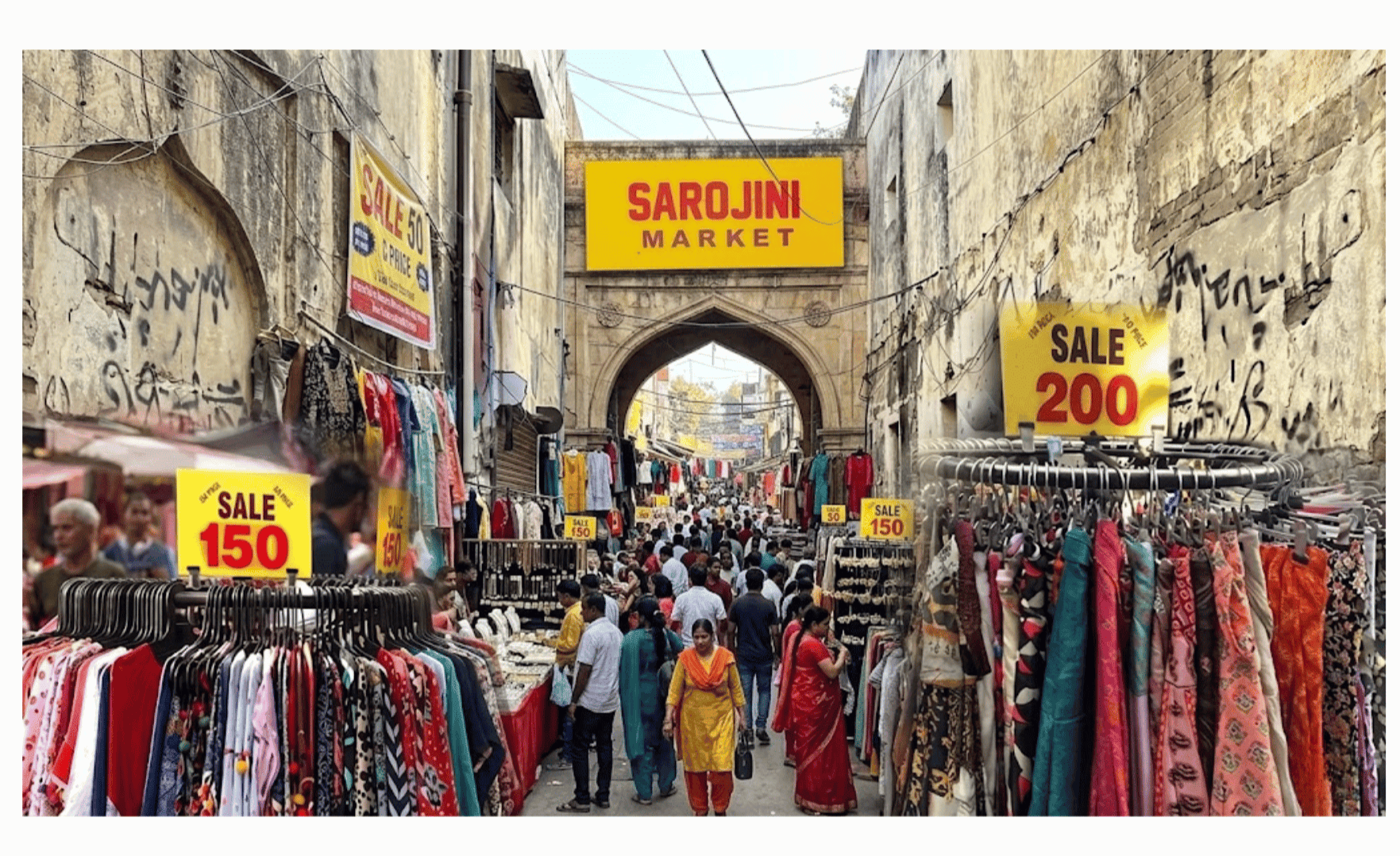
    Saturday or Sunday, that is when we decide to go out and shop. Sarojini Nagar is packed every single day. Not just weekends. Like, there’s a permanent sale that never ends. Clothes, home decor, accessories, everything is available at prices already low enough to make you stop and look. And if the price still feels like too much, we bargain it down further.

    We walk away feeling like we won something. A small sense of victory, a quiet pride in having paid the least possible.

    But is it really a victory?

    sarojini nagar fast fashion dump yard

    There is an old saying that says when something costs almost nothing, somebody somewhere is quietly paying the rest of the price.

    In India, we are taught to be the masters of the bargain. We pride ourselves on getting the lowest price. However, our obsession with “cheap” is creating a “race to the bottom” that is destroying our environment, our labor force, and, surprisingly, our own bank accounts.

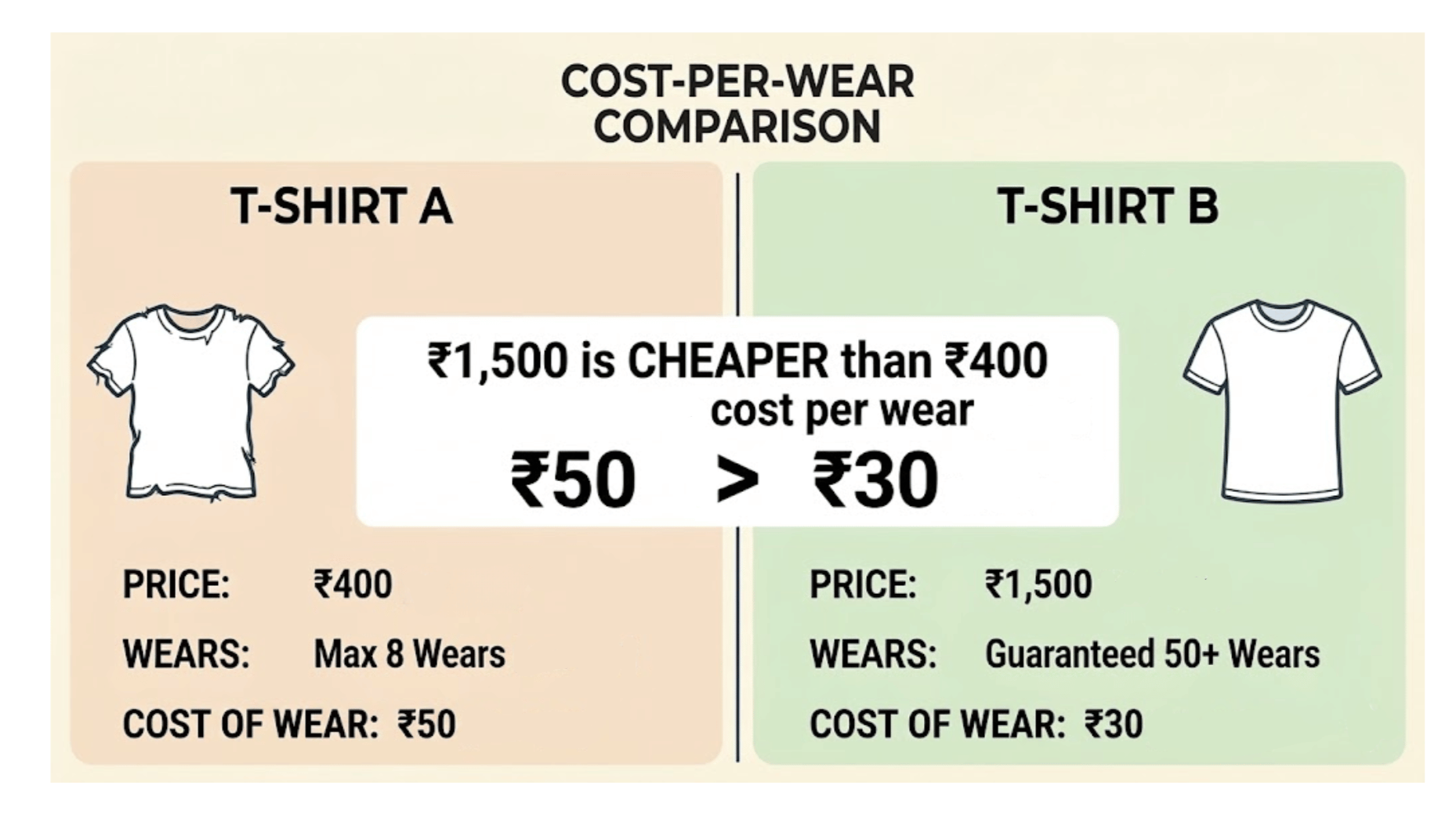
    1. The Math of “Cost-Per-Wear”: Why ₹1500 is Cheaper than ₹400

    Take two plain cotton t-shirts.

    One costs ₹400, the other ₹1,500.

    Cost per wear analysis of fast fashion tshirt vs sustainable tshirt

    According to the Ellen MacArthur Foundation, the average person now wears a piece of clothing only 7 to 10 times before tossing it.

    The cheaper one shrinks after a few washes, the seams loosen, and the color goes dull. You get maybe 8 wears out of it, ₹50 per wear.

    The pricier one, made with better cotton and actual stitching, lasts through 50 wears easily, at ₹30 per wear.

    Over time, the “expensive” sustainable shirt is actually 40% cheaper than the fast fashion one. When we buy clothes, we’re not saving money; we’re just buying more and more.

    2. The Sarojini Effect: Psychology of the “Dump.”

    India has become a dumping ground for global fast-fashion surplus. Markets like Sarojini Nagar are no longer just about local thrift; they are visual evidence of overproduction. Because prices are so low, our psychology shifts.

    We stop buying based on need and start buying based on impulse. Brands use “exploitative trends”, releasing new “drops” every week to make you feel that what you bought last month is already obsolete. The word “Fast” doesn’t just refer to the speed of the sewing machine; it refers to how quickly a brand wants that garment to throw them away.

    3. The Hidden Human Cost: Would You Work for ₹300?

    We live in an India that dreams of progress.

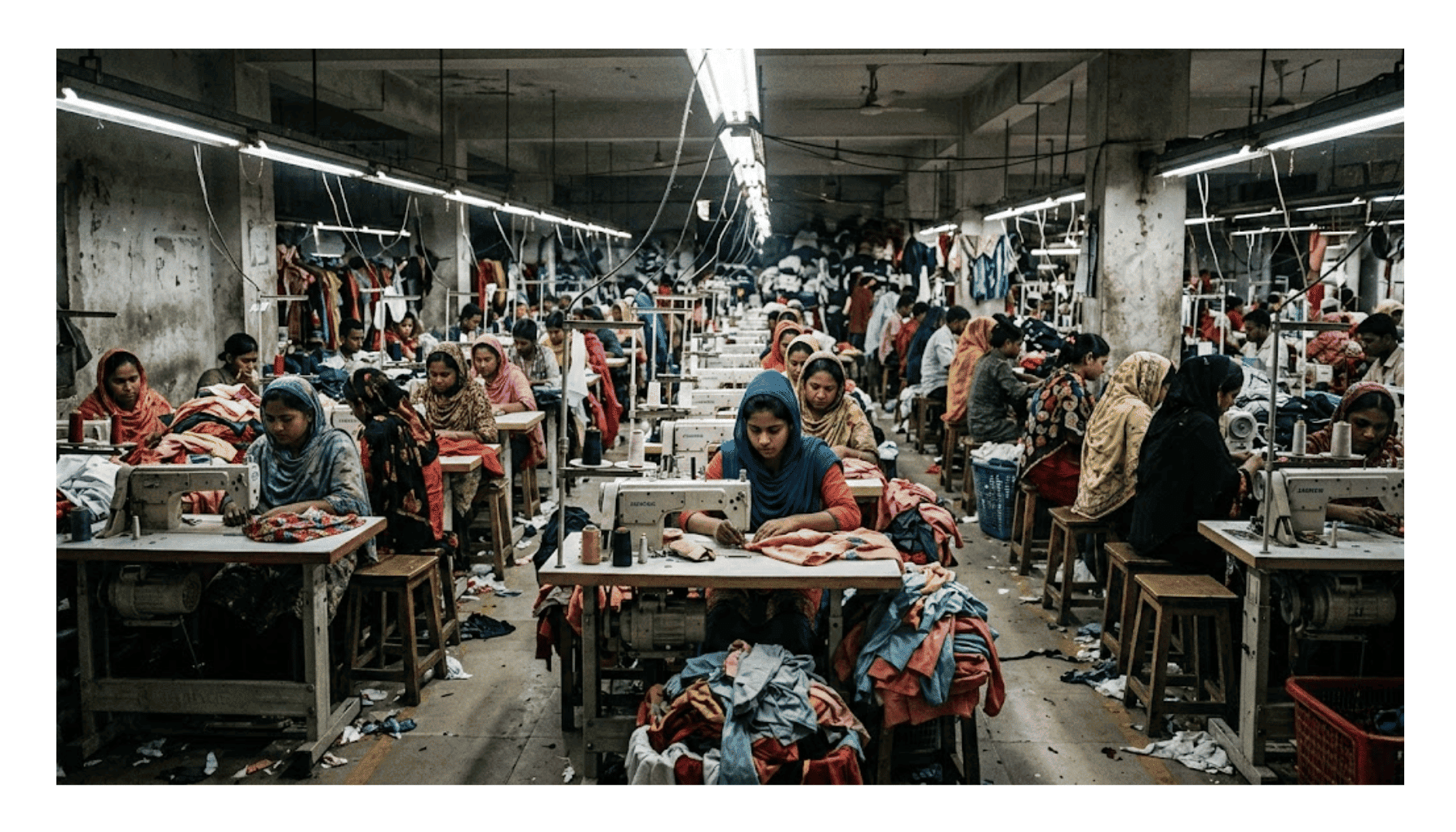
    We want five-day work weeks, hybrid offices, health insurance, PF contributions, and 30 days of paid leave. These are fair things to want. While we fight for “work-life balance,” someone worked 15 hours for ₹300 in the textile industry

    Without weekends, without insurance, without much of a safety net. Sometimes entire families get pulled into the work just to keep pace with demand. Not because their time is worth less, but because the system we keep feeding with our purchases has decided it is.

    unfair working condition of people working in textile industry

    Unequal wages aren’t some distant issue tied to factories we’ll never see. They’re much closer than that. Just look around.

    The dhobi who brings back your clothes neatly pressed. The cobbler outside the market has spent years repairing shoes. The tailor who fixes, alters, and makes things fit just right. The bai who quietly keeps your home running so your day can run smoothly.

    These are people whose work we rely on almost every day. Yet their wages are often the first thing we bargain over.

    This isn’t about guilt. It’s about awareness. The same things we want in our own jobs, fair pay, dignity, and respect for our work, belong to them too.

    You realize this the moment you step outside India. Abroad, a simple alteration is a luxury. A handmade piece costs a small fortune. A cobbler, if you can find one, charges what the skill is actually worth. And you stand there thinking, we have all of this back home. In every lane, in every market, in every small town. We are genuinely blessed with talent that most of the world would pay handsomely for.

    So the least we can do is pay fairly. Not out of guilt, but out of gratitude. Because these hands are keeping something alive that deserves to survive. And if we keep asking them to do it for less and less, one day we will look around and find that the skill, and the person behind it, has quietly disappeared.

    Nothing on that receipt will tell you any of this. But now you know.

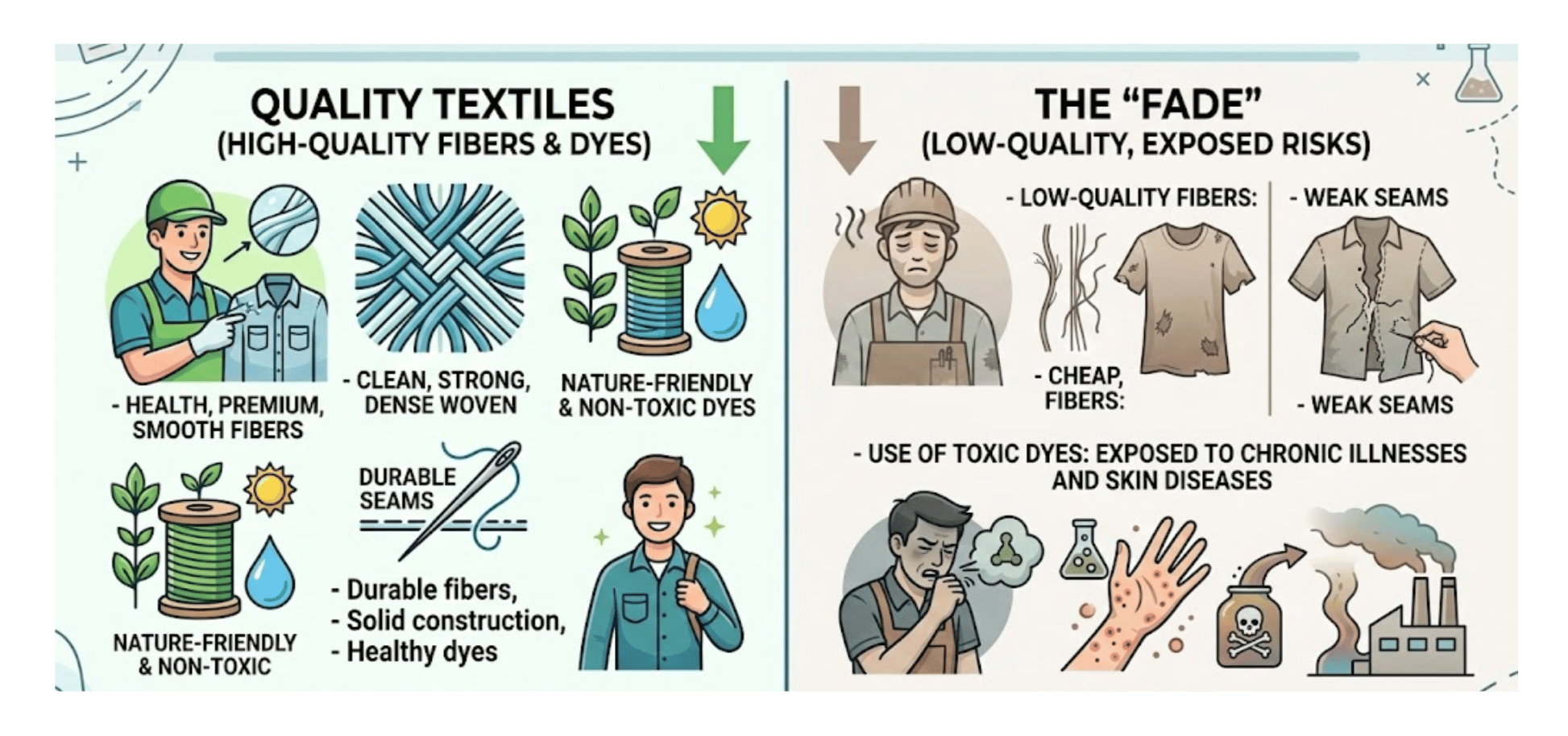
    What cheap fabric is actually made of

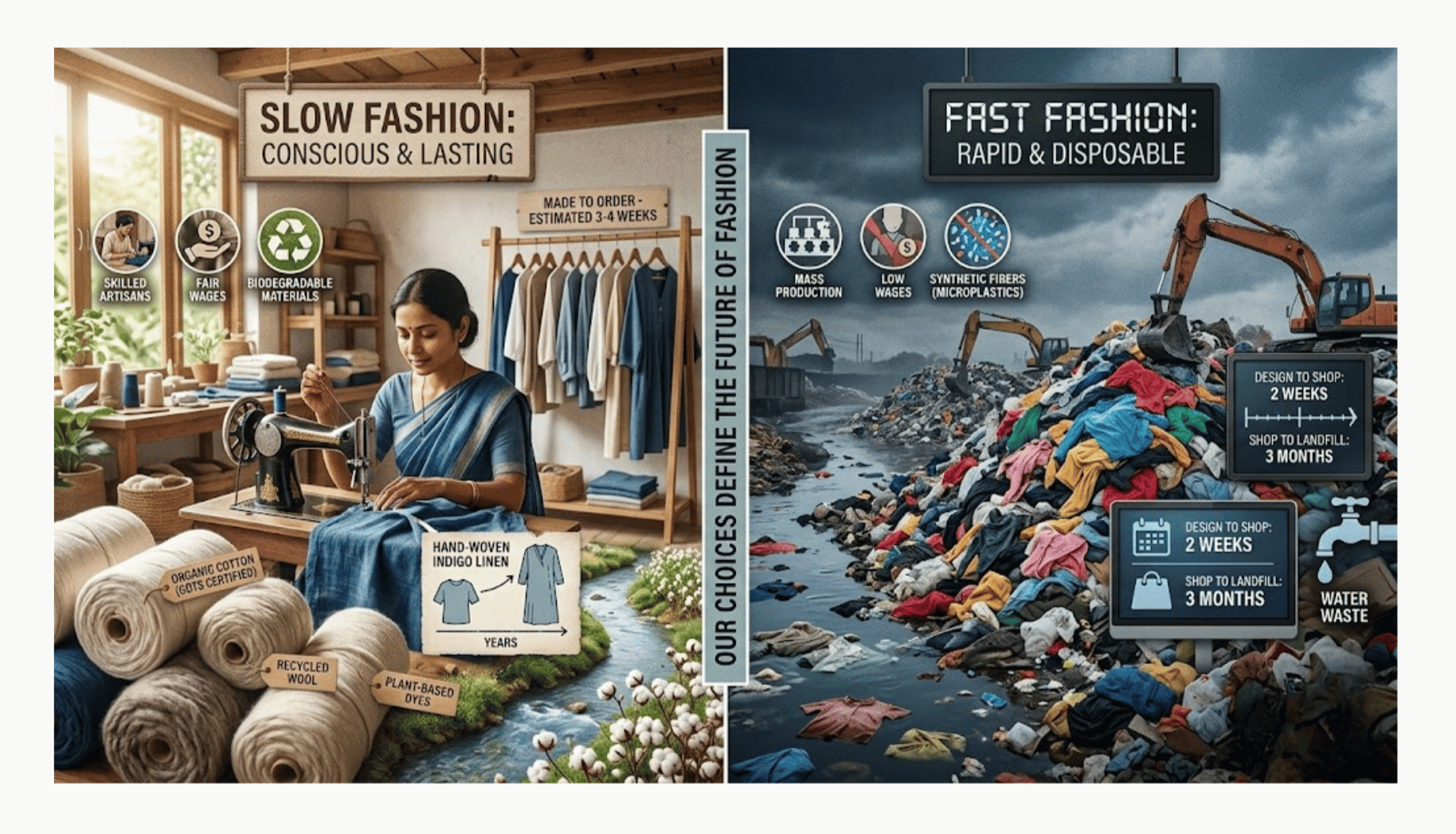
    To keep prices low, fast fashion cuts corners on material, on dye, on stitching.

    Synthetic blends that trap heat in an Indian summer.

    Seam that give out after a handful of washes.

    Dyes (often toxic) that workers handle daily, breathing in what eventually shows up as chronic illness.

    Quality of fast fashion vs slow fashion textile

    When you pay more for a slow fashion piece, some of that money goes to the farmer who grew organic cotton, the person who used safer dyes, and the tailor who took time on the stitching because the garment was meant to last.

    And every time a cheap synthetic shirt gets washed, thousands of microfibers enter the water. Rivers, groundwater, eventually the sea. It adds up quietly, the way most permanent damage does.

    If you want to go deeper into how far the damage travels, from the cotton farm to your wardrobe, I have covered the full impact of the cloth value chain in a previous article. Worth a read.

    What the price tag isn’t telling you

    Real value was never just the number at the billing counter. It is how long something serves you, and what it took from the world to get made. The next time something is priced at ₹299, the honest question to sit with is who paid the rest?

    Buy less. Buy better. Local. And pay the full price, not just the one that shows up on the tag.

  • Eco-Friendly Holi 2025: Celebrate With Joy, Not Waste | Greener Living

    Eco-Friendly Holi 2025: Celebrate With Joy, Not Waste | Greener Living

    The smell of gulal in the air. The color in your hair. The laughter from the street. The feeling of not caring how you look. Buckets of water. Music too loud. Faces are unrecognizable and happy.

    But stop for a second. Compare Holi from your childhood to Holi today. The scale is bigger. The waste is bigger. The chemicals are stronger. And the water use? Out of control.

    You can celebrate fully. You just need to celebrate smarter.

    The Water Crisis We Pretend Doesn’t Exist

    You’ve seen it.

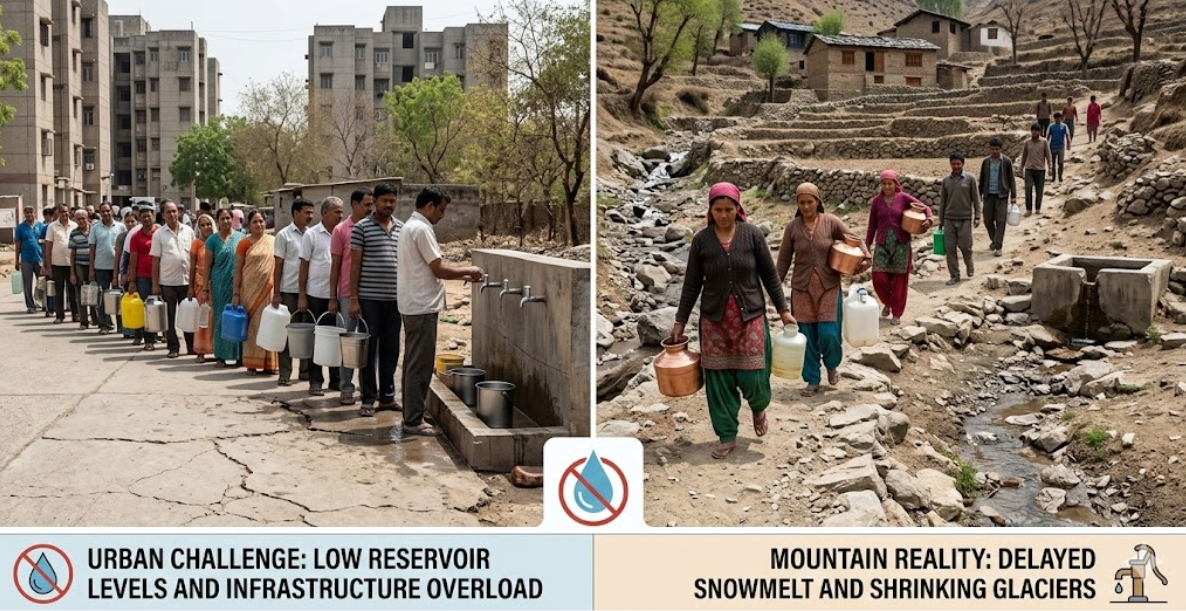
    Water tankers lined up in colonies. Dry taps in April. Borewells are going deeper every year. According to NITI Aayog, nearly 600 million Indians face high to extreme water stress. And even when water does show up, it isn’t always safe to drink. People are falling sick from something as basic as a glass of water.

    Climate change makes it worse. Summers arrive earlier. Monsoons shift. Snowfall in the Himalayan regions comes late, which delays meltwater that feeds rivers and reservoirs.

    Water scarcity in urban and mountain region.

    In hill states, delayed snowfall is not an inconvenience. It’s a survival risk.

    And in the plains?

    We fill thousands of water balloons.

    A Bucket vs. A Hose

    One bucket is a celebration. A running hose for three hours is a waste. If your area already faces shortages, choose dry Holi. You won’t lose the fun. You’ll gain responsibility.

    The Hidden Chemicals in Your Colors

    Those neon pinks and electric greens look festive. But many cheap powders contain industrial dyes mixed with heavy metals like lead, chromium, and mercury.

    They don’t disappear after you wash them off.

    They enter the soil. Drains. Rivers. Hospitals report spikes in skin rashes, eye irritation, and respiratory problems right after Holi every year. And then there’s the packaging. Thin plastic pouches. Single-use wrappers. Most of it is non-recyclable.

    It stays long after the colors fade.

    Holika Dahan: When Symbolism Turns Wasteful

    Holika Dahan represents the victory of good over evil. It’s powerful. It’s cultural. It’s meaningful.

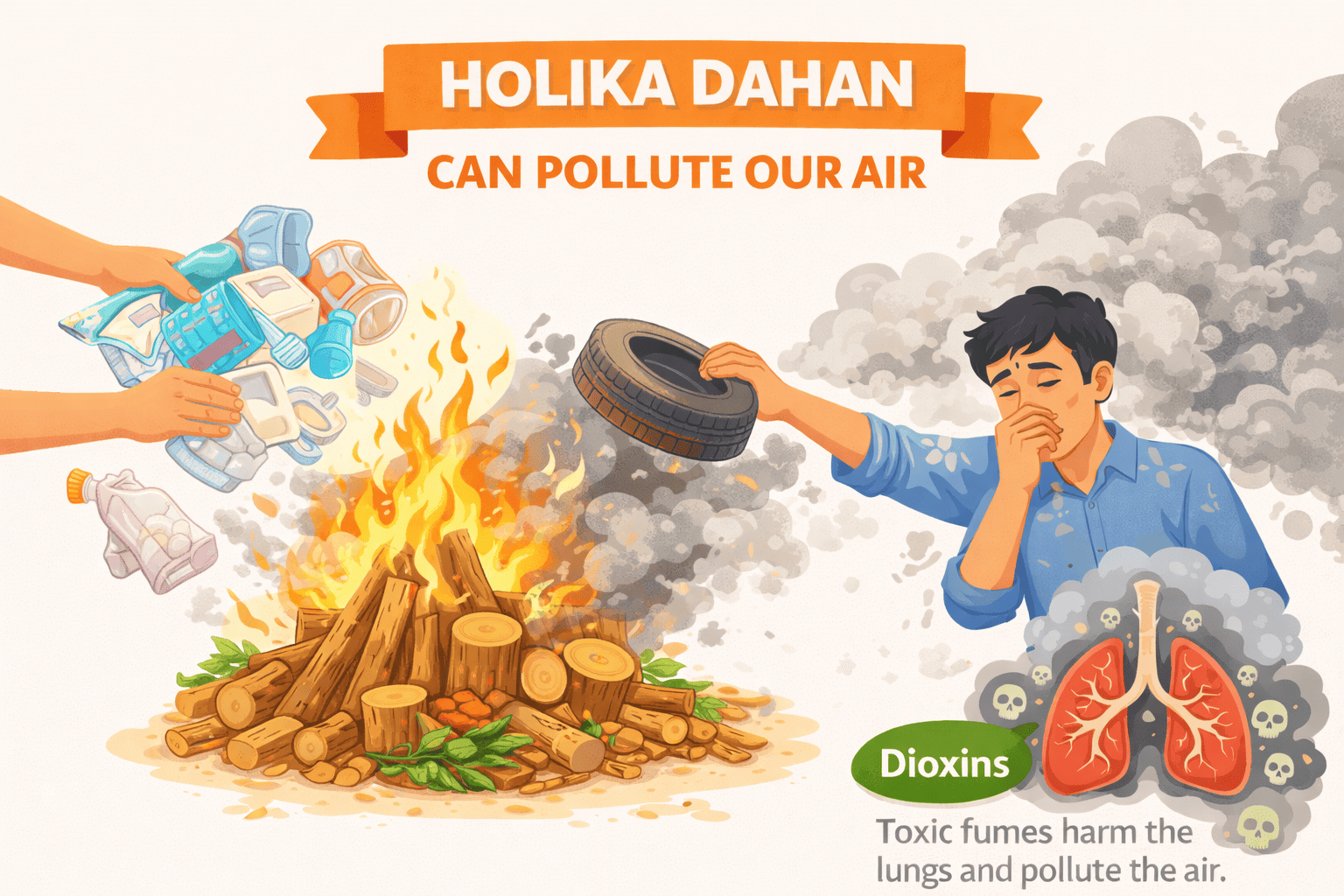
    But look at what we burn today. Large quantities of wood. Sometimes, freshly cut trees. Often mixed with plastic waste, tyres, or synthetic materials. When plastic burns, it releases toxic fumes like dioxins. These harm the lungs and instantly pollute the air. 

    holika dahan, plastic and air pollution

    A symbolic community bonfire is enough. A massive smoke cloud is not devotion. It’s pollution.

    Encourage your community to:

    • Use dry agricultural waste instead of cutting trees
    • Avoid plastic and synthetic materials completely
    • Keep the bonfire meaningful, not massive

    The Plastic Aftermath

    The morning after Holi tells the real story.

    Burst balloons everywhere. Broken plastic pichkaris. Empty color packets are scattered across the streets.

    Municipal workers face one of their toughest cleanup days of the year. Most small plastic toys and packaging used during Holi are low-grade plastic. They are rarely recycled. They go straight to the landfill. Or worse, they clog drains and enter water bodies.

    Holi adds to that spike.

    But you can reduce it easily.

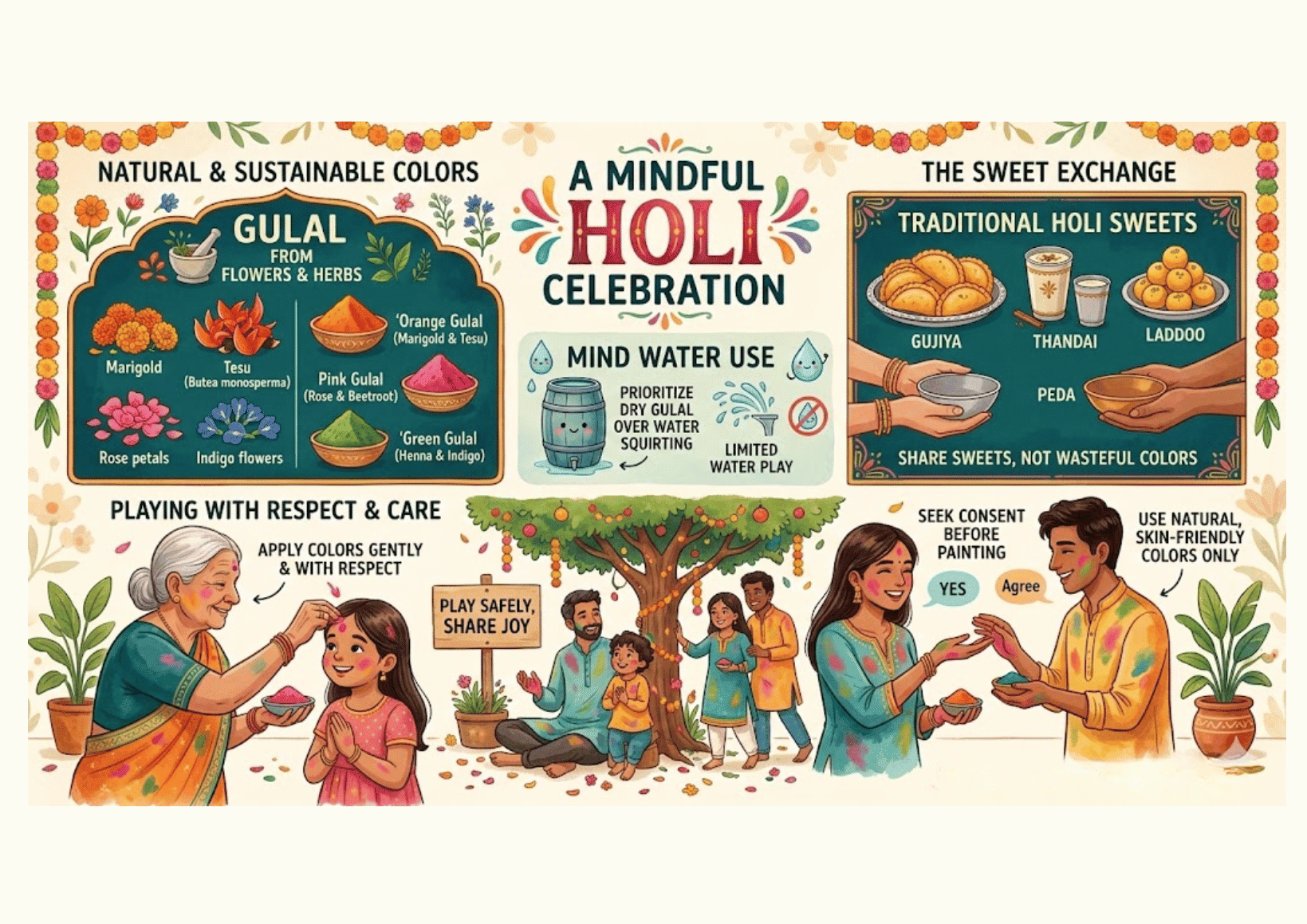
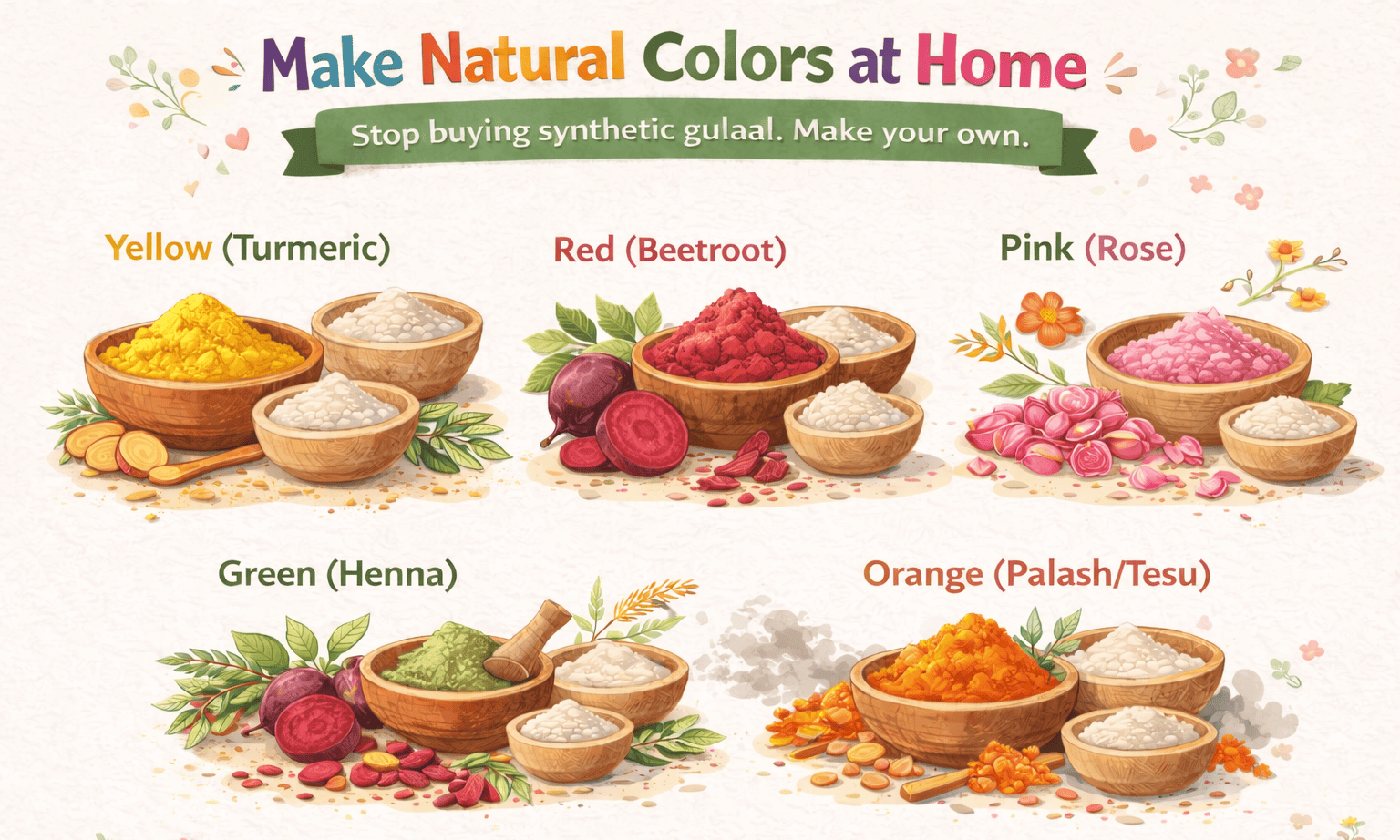
    Make Natural Colors at Home

    Stop buying synthetic gulaal. Make your own.

    Yellow (Turmeric): Mix 2 tbsp turmeric + 2 tbsp gram flour. Done.

    Red (Beetroot): Dry beetroot slices for 2-3 days. Grind to powder. Mix with cornstarch.

    Pink (Rose): Dry rose petals (from temples). Grind with rice flour.

    Green (Henna): Dry henna leaves. Powder them. Mix with cornstarch.

    Orange (Palash/Tesu): Dry traditional orange flowers. Grind. Mix with a flour base.

    100% natural and organic, zero chemical, safe

    They’re softer than synthetic colors. They fade faster.

    Buy From These Certified Brands

    Some of the brands are:

    Phool.co

    iTokri

    • Orchids, roses, turmeric base
    • ₹690 for a pack of 6
    • Non-allergic claim

    Nirmalaya

    • Recycled temple flowers
    • IIRT certified
    • Starting from ₹70

    Lattooland

    • Taste-safe formula
    • Lab-tested
    • Good for kids
    • Starting from ₹399

    Earth Inspired

    • NABL Lab tested
    • 100% Natural
    • ₹399 for a pack of 6

    Advait Living

    • Empowers Farmers
    • Has a recycling option
    • Starting from ₹145

    The Shift Is Already Happening

    A few simple and meaningful changes can make a difference.

    Set a limit on the water you use. If your area is already short of water, think about not using water for Holi this year.

    Do not use water balloons at all. They are fun for a second, but then they leave behind plastic that cannot be recycled.

    Buy things from local sellers and buy them early. Local sellers who sell colors often do not sell as much as big companies that sell synthetic colors. When you buy from sellers, you are helping to make the supply chain better.

    Keep your Holi clothes instead of throwing them away after one use. It is an idea to use old clothes for Holi every year. This helps to reduce waste from clothes.

    Talk to your friends about these things. When we talk about these things, it can help to change people’s habits. You might be the one who helps someone change their habits this year.

    You don’t need to make Holi smaller.

    You need to make it better.

    More intentional. More connected. More aligned with what it celebrates: renewal, spring, life.

    Mother Nature already gave you every color you need.

    Celebrate her with respect.

    Happy Holi. Play beautifully.

  • Return Fraud: The Growing Problem in E-Commerce

    Return Fraud: The Growing Problem in E-Commerce

    You buy a kurta set on Myntra. Wear it to that wedding. Tags still on, carefully tucked away. Take your photos for Instagram. Return it three days later. Free rental, right? Except Myntra can’t resell it now. So it gets tossed. Or shipped to some liquidation warehouse. Or worse. This is return fraud. And in India, it’s not just destroying retailers’ profits. It’s creating mountains of waste.

    The Numbers in India Are Wild

    India’s e-commerce return rate sits between 25-40% during festive seasons. That’s one in three orders coming back.

    In 2024, return fraud cost Indian e-commerce platforms billions. Myntra alone lost ₹50 crore nationwide to refund scams. Meesho got hit for ₹5.5 crore by just three fraudsters in Gujarat.

    All that merchandise? Either destroyed or dumped.

    What Counts as Return Fraud Here?

    Wardrobing is massive in India. Many customers buy clothes in multiple sizes just to try them on and return the rest. Not “maybe” return. Plan to return.

    Cash on Delivery (COD) fraud. People order stuff, don’t have cash when it arrives, and refuse delivery. The product goes back. Cash on Delivery orders consistently show higher return rates than prepaid purchases. Research indicates that around 40% of COD orders are returned, compared to an overall average of 20% across online retail. In simple terms, nearly two out of five COD shipments never make it past the customer’s doorstep.

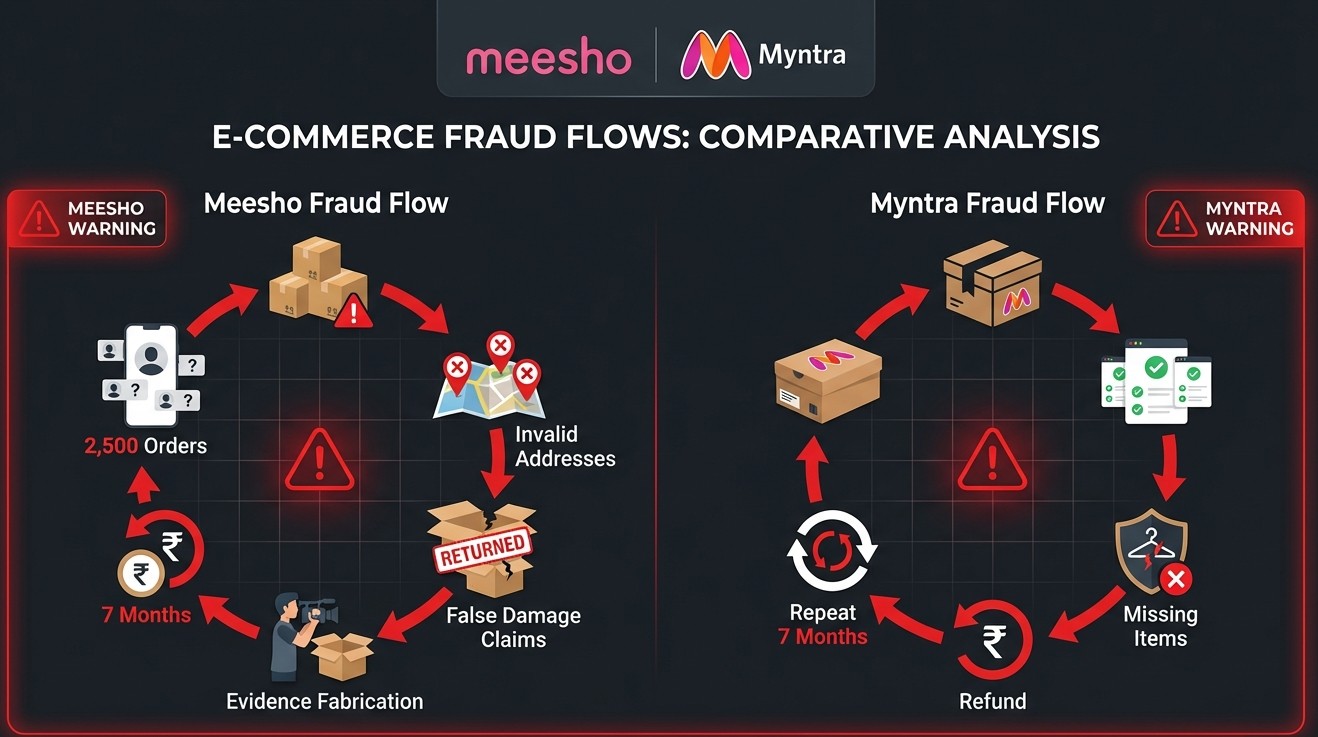
    Then there’s refund fraud. The Meesho case? Three guys created fake buyer accounts and placed around 2,500 orders using invalid addresses, causing all shipments to be returned. They then filmed opened parcels and falsely claimed the items were damaged to secure reimbursements. The scheme ran for seven months.

    Return Abuse in Fashion E-commerce meesho and myntra case

    The Myntra gang ordered branded shoes and claimed they received fewer items than ordered. Filed 5,529 fraudulent orders in Bengaluru alone.

    Why Indian Retailers Throw Stuff Away

    According to a report by the National Retail Federation (NRF), about 9% of all returns are fraudulent. Retailers tracking these cases say almost 70% have seen a rise in customers overstating the number of items they’re returning. Many also report more empty-box scams and cases where genuine products are swapped with counterfeit or decoy items.

    In India? It’s worse.

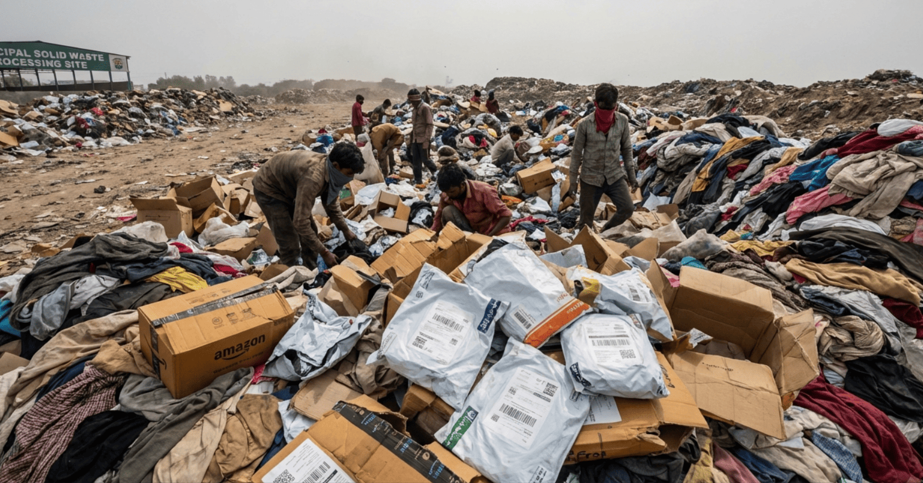
    Landfill Site in India with Discarded Clothing and Packaging Waste

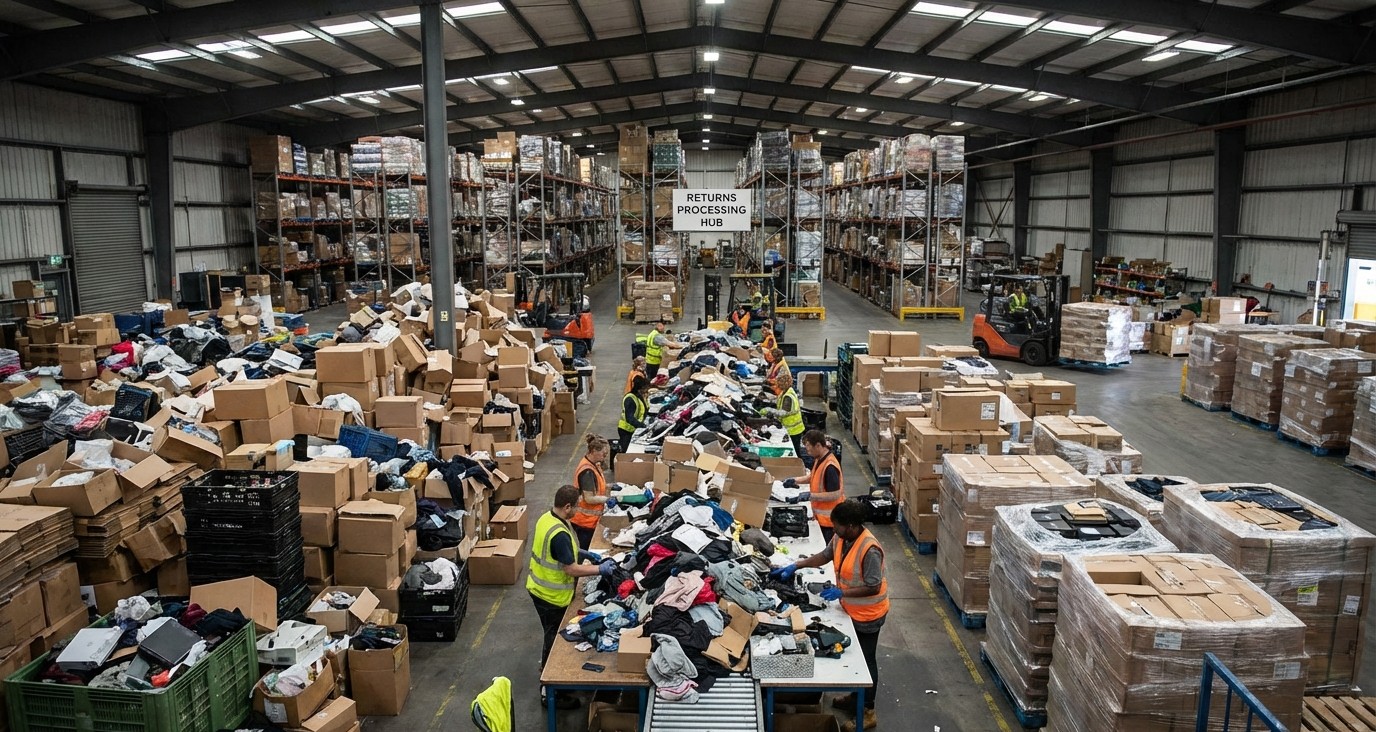
    Small D2C brands struggle to track returns. They lack reverse logistics infrastructure. So when a product returns from a tier-2 or tier-3 city, the expense of shipping it to a warehouse, checking its quality, repackaging it and then relisting it becomes more than the item is worth.

    Cheaper to dump it.

    Damaged products or products claimed to be damaged can’t be resold. They go straight to landfills.

    India’s reverse logistics market is growing rapidly, driven by the increasing number of e-commerce returns. But growth has not entirely addressed the capacity gap. Infrastructure, sorting systems and refurbishment networks are not yet keeping pace with the demand. As a result, many of those returned products never find their way back into resale or recycling channels. Instead, they depreciate rapidly and far too frequently, and end up as trash.

    The Environmental Toll Is Brutal

    Every return creates emissions. The delivery guy picks it up. A truck moves it to a sorting centre. Another truck to a warehouse. Maybe another to liquidation.

    In India, where logistics networks are less efficient than those in developed countries, there’s a lot of carbon emitted going back and forth like this. Broken goods in the landfill? They pollute soil and water. Waste from packaging returns such as bubble wrap, cardboard, and plastic tape, piles up quickly.

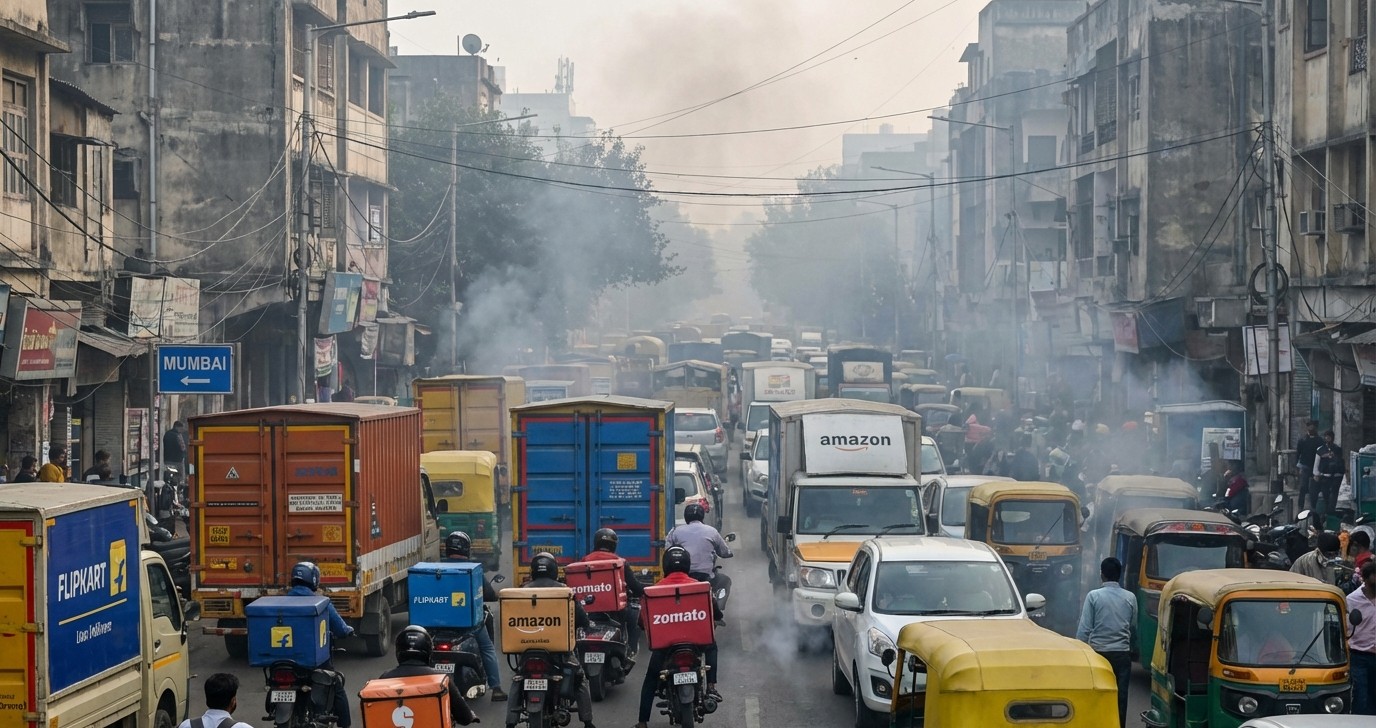
    Heavy Indian City Traffic with Delivery Vehicles

    Both fashion return rates and size spikes up drastically during major festive sales like Big Billion Days or Great Indian Festival. That can mean millions of items all move back through the supply chain at once, and a large portion never make it as far as inventory. Instead, a majority of them land in liquidation channels or on the way to disposal.

    And nobody’s tracking it. The environmental cost of returns isn’t part of anyone’s reporting.

    Why This Keeps Getting Worse in India

    Free returns. That’s the core.

    Flipkart, Amazon and Myntra all offer 10-30 day no-questions-asked return policies to compete. 92% of Indian shoppers specifically look for easy and free returns before buying.

    Social media made it worse here, too. Instagram reels and YouTube hauls normalise buying stuff just to show it off and send it back.

    Cash on Delivery is another factor. Nearly half of India’s e-commerce transactions are COD. It’s convenient, but creates massive RTO rates when people change their minds or don’t have cash.

    Youtube, instagram , facebook product haul

    Nearly 26% COD orders come back, compared to less than 2% for prepaid orders. In practical terms, that makes COD returns more than ten times higher than prepaid returns.

    And there’s size/fit uncertainty. Standardised sizing doesn’t work. So people buy multiple sizes because they know at least two won’t fit. Free returns enable this behaviour.

    Indian Platforms Are Fighting Back

    Flipkart launched an AI tool called “Mira” to reduce its return rate by asking shoppers a few questions before purchase to prevent size/fit issues.

    Myntra uses “Sabre,” an AI that analyses past return patterns to detect fraud. It can tell the difference between genuine returns and serial returners gaming the system.

    They’ve also started:

    • Blocking COD for customers with high return rates
    • Charging return fees after a certain point
    • Restricting refunds for repeat offenders
    • Flagging customers who return excessively

    But there’s a problem. 55% of Indian consumers avoid buying if return policies are too strict.

    So platforms are stuck. Tighten policies, lose customers. Keep them loose, lose money and create waste.

    What Actually Happens to Returns in India

    Best case? The item gets inspected at a return centre in Mumbai or Bengaluru, repackaged, and re-listed.

    But that’s rare.

    More often, returns get:

    • Sold to liquidators at a steep discount, recovering only a small portion of their original price.
    • Donated (if in decent condition and someone bothers)
    • Sent to tier-2/3 city markets in bulk
    • Destroyed

    Indian e-commerce companies don’t publicly share how much they destroy. But based on global averages (25% of returns destroyed), and India’s higher return rates plus weaker

    reverse logistics, the destruction rate here is likely higher. Some of it ends up in Panipat’s textile recycling market. But most? Landfills.

    The Real Cost

    Return fraud costs Indian e-commerce thousands of crores. But that’s just money. 
    Water. Energy. Carbon. Chemicals. Labor. All wasted because someone wanted it for one night.

    And most people are wardrobing or doing COD fraud? They don’t see it as fraud. They see it as smart shopping.

    It’s normalised. Expected. Part of the game.

    But someone’s paying. And it’s not just Flipkart.

  • The True Cost of a Cotton T-Shirt: Environmental Impact & What You’re Really Paying For

    The True Cost of a Cotton T-Shirt: Environmental Impact & What You’re Really Paying For

    You’re probably wearing a cotton T-shirt right now.
    Maybe it feels soft because you’ve washed it many times. Maybe it’s new and still has a hint of factory smell. Perhaps it’s the shirt you wear to the gym or for sleeping. 

    But have you ever thought about what it takes to create that simple item of clothing?

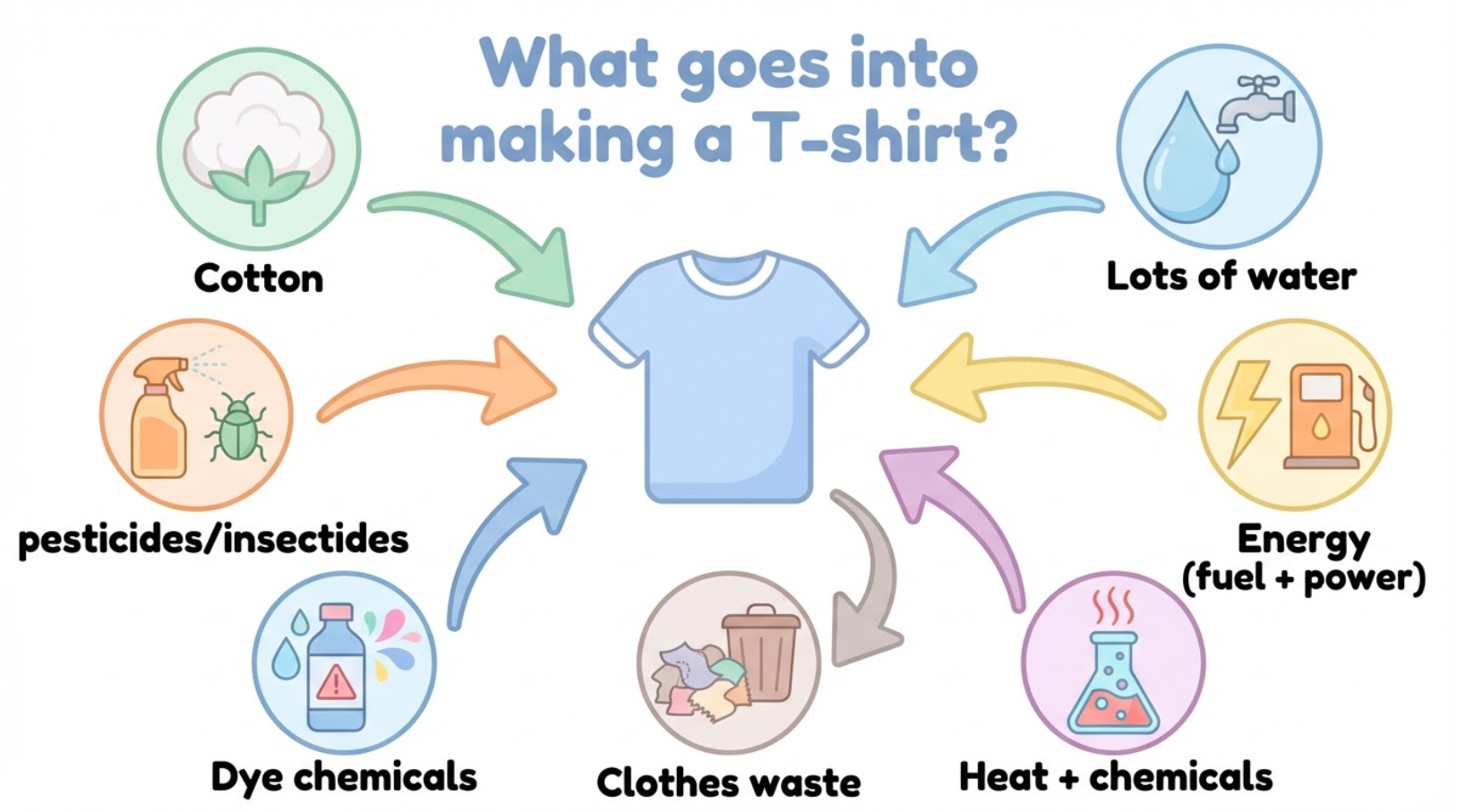
    Behind that soft fabric is a story most of us never see. Producing a single cotton T-shirt requires about 2,700 liters of water. This simple piece of clothing has made textiles one of the most polluting industries in the world.

    Let’s look at the life cycle of a cotton T-shirt, from the cotton field all the way to the landfill, and see what happens at each stage.

    1. It Starts in the Field: Cotton Farming

    Let’s begin at the start: the field.

    Cotton is a very thirsty crop. In India, most cotton farms depend on monsoon rains. Climate change has made these rainfall patterns unpredictable. When the rains don’t come, farmers rely on groundwater to save their crops. It drains aquifers that whole communities depend on for drinking water. In severe cases, it can make drought conditions worse.

    Cotton is highly vulnerable to pests, especially cotton bollworms. Farmers rely on synthetic pesticides and chemical fertilizers to protect their plants.

    Flowchart showing environmental impact of cotton farming and water shortage.

    Organic cotton farming avoids syntahetic pesticides completely, yet conventional cotton still dominates the global market.

    And at this point, the T-shirt is still on the farm.

    2. Turning Cotton Into Fabric: Energy-Intensive Manufacturing

    After harvesting, cotton moves to factories.

    The fibers are separated from seeds through ginning.

    They are spun into yarn and then woven or knitted into fabric. After that, the fabric goes through chemical treatments and heat processes to become softer, smoother, and whiter. 

    Carbon emissions from manufacturing of a cotton t-shirt.  
process of making yarn from fabric

    Each of these steps uses energy.

    Textile manufacturing produces 2 billion tons of carbon dioxide emissions each year, making it a major contributor to pollution.

    3. The Most Toxic Stage: Dyeing and Finishing

    This is when your T-shirt gains its color, softness, and the “won’t shrink” label. It’s also the stage where the environmental impact increases.

    Textile dyeing uses a lot of water and relies heavily on chemicals. 

    Environmental impact from textile dyeing
fast fashion pollution

    Untreated waste water flows directly into rivers and lakes. This causes oxygen loss in water, making fish suffocate. Bright dyes block sunlight, killing aquatic plants and harming ecosystems. Toxic chemicals accumulate in the food chain.

    After dyeing, the fabric is cut and sewn to make the T-shirt you buy. 

    Garment manufacturing often comes with a heavy human cost. Many workers face tough conditions, long hours, and low pay. These issues show the real price behind the clothes we wear every day. 

    If a T-shirt has a crooked seam or small color difference, it might get rejected and get into landfill or incinerated. All the water, energy, chemicals, and labor put into it are wasted. 

    Some rejected shirts are sold cheaply in bulk, but many more end up incinerated or in landfills. Every T-shirt you wear comes from someone’s labor. That’s worth considering.

    4. Transportation and Sales

    Most T-shirts are made in developing countries and sold in wealthy nations. This means they cover long distances before arriving at a store or your home. Packaging, shipping, freight, warehousing, and distribution all increase the garment’s carbon footprint. 

    Moving millions of garments across oceans and continents needs fuel, infrastructure, and energy.

    5. The Use Phase: Your Habits Matter

    What happens after you buy it often has a longer-lasting effect. Every time you wash it, especially with hot water, tumble dry it, or iron it, you raise its environmental impact.

    Research shows that the use phase makes up a large part of a garment’s total carbon emissions and energy use during its lifetime. That’s why your laundry habits matter more than you might think.

    6. End of Use: Landfill Challenge

    Ultimately, every T-shirt ends up at the last phase of its lifespan.

    Some are donated.
    A small portion (<1%) is recycled.
    But most go to landfills.

    Here’s the irony.

    textile waste landfill

    Cotton is a natural fiber that produces methane (a potent greenhouse gas) when it decomposes without oxygen in a landfill. 

    So even when you throw it away, your T-shirt still adds to climate change.

    Now multiply this by 2 billion.

    About 2 billion cotton T-shirts are sold worldwide every year. 

    Now multiply everything we’ve discussed by that number.
    Billions of liters of water flow through rivers and seas every day.
    Tons of toxic chemicals
    Massive carbon emissions are a major cause of climate change and harm our planet’s health. 

    Reducing these emissions is crucial to protect the environment and ensure a sustainable future for everyone.

    What You Can Do: 

    Sustainable Alternatives offers simple ways to replace everyday items with eco-friendly options. 

    Choosing reusable bags, conserving water, and using energy-efficient appliances can reduce waste and save resources.
    Switching to sustainable products helps protect the environment while still meeting daily needs.
    Small changes in how we buy, use, and get rid of clothing can make a real difference. Look for GOTS, OEKO-TEX, or Fair Trade certifications.

    Sustainable clothing practices for a greener future

    Fast fashion may seem affordable, but its true cost goes beyond price tags. A cotton T-shirt looks simple. It feels simple. It’s usually inexpensive. Yet behind it is a chain of environmental and human impacts that spans continents. The industry needs a systemic overhaul, and that’s clear. Awareness is where change begins. 

    So next time you pick up a T-shirt, pause and reflect.

    References

    1. https://file.scirp.org/Html/4-8301582_17027.htm
    2. https://earth.org/fast-fashions-detrimental-effect-on-the-environment/
    3. https://www.fashionrevolution.org/the-true-cost-of-colour-the-impact-of-textile-dyes-on-water-systems/
    4. https://www.silkandwillow.com/blogs/inspiration/the-hidden-cost-of-color-toxic-chemicals-in-textile-dyes
    5. https://jepha.springeropen.com/articles/10.1186/s42506-024-00167-7
    6. https://www.sciencedirect.com/science/article/pii/S2452072119300413

  • Turn your designs into income with TeeEvo.

    Your Art, Your Empire: The Ultimate Guide to Print-on-Demand with TeeEvo

    You may already have designs saved on your computer, sketches in a notebook, or an Instagram page where people comment, “I’d buy this on a shirt.”
    If you’ve ever thought about turning your creative ideas into real products, this guide shows you exactly how.

    With print-on-demand, creators can sell custom products online without inventory, upfront costs, or risk, and TeeEvo is built to make that process simple, transparent, and creator-first.

    Why Print-on-Demand Is Growing Fast

    The creator economy and demand for personalized products continue to rise. Consumers want meaningful, custom items, and creators want business models that don’t require heavy investment.

    • The global print-on-demand market was valued at nearly USD 10 billion in 2024
    • Growth is driven by e-commerce, personalization, and sustainable production
    • Small brands and independent creators are leading this shift

    Print-on-demand fits perfectly into how people shop today.

    exponential growth of pod business

    Where TeeEvo Fits In

    TeeEvo is more than a print-on-demand service. It acts as your production partner, fulfilment team, and digital storefront, all in one platform.

    TeeEvo is built for:

    • Independent creators and artists
    • Designers building clothing brands
    • Local print shops moving online

    Everything is designed to help you turn creative ideas into sellable products without technical friction.

    How to start selling on TeeEvo (Step-by-Step)

    Step 1: Choose a profitable Print-on-Demand niche

    Successful POD brands don’t design for everyone. They design for specific, passionate audiences.

    High-demand niches include:

    • Anime and pop culture designs
    • Artistic and expressive illustrations
    • Music, band, and lyric-based graphics
    • Automotive culture (cars, bikes, motorsports)
    • Clean typography and quote-based apparel
    sustainable pod india
Oversized black organic cotton t-shirt with a minimalist white typography design on a male model. High-quality sustainable streetwear India.

    Ask yourself:

    • What niche am I already part of?
    • What designs are popular but poorly executed?
    • What would I actually buy?

    Finding this overlap gives you a competitive edge.

    Step 2: Design With Real-Time Pricing Transparency

    One of the biggest challenges in print-on-demand is unexpected production costs.

    TeeEvo solves this with real-time pricing visibility:

    • Larger print areas = higher cost
    • Smaller, minimalist designs = lower cost
    • You see your margins while designing, not after

    This helps you design smarter and price confidently.

    oversized-streetwear-tshirt-design-india

premium-organic-cotton-tshirt-lifestyle-shot

custom-printed-black-tee-male-model-street-style

unisex-graphic-tshirt-sustainable-fashion-brand

high-quality-dtg-print-on-white-cotton-tee
ai-tshirt-design-tool-interface-dashboard

text-to-design-ai-generator-for-apparel

custom-tshirt-creator-online-no-design-skills

real-time-pricing-calculator-for-custom-clothing

digital-mockup-generator-for-streetwear-creators

    A Safer Way to Start

    Lower Risk for Beginners

    You can start with smaller designs, order low-cost samples, and test quality before scaling—making TeeEvo ideal for first-time POD sellers.

    Step 3: Create Your Online Store

    Setting up a TeeEvo store is simple, beginner-friendly, and completely free.

    You can:

    • Create a free storefront
    • Upload designs
    • Choose fabrics and branding options
    • Preview realistic product mockups

    You control pricing, branding, and presentation, without hidden fees.

    Step 4: Upload, Price, and Finalize Products

    Before launch:

    • Review how designs look on different products
    • Set pricing based on quality and target audience
    • Decide whether to offer introductory discounts

    These decisions shape how customers perceive your brand and value.

    Step 5: Launch and Promote Your Products

    Promotion connects your designs to buyers.

    Print on demand India, Start a clothing brand India, Custom t-shirt printing online, Sustainable streetwear India
Dropshipping apparel India, No inventory business ideas, Direct to garment printing service, Passive income for artists
Create a free online store, Best POD platform for creators, Design your own t-shirt

    Best platforms for print-on-demand marketing:

    • Instagram and Instagram shops
    • Facebook business pages
    • WhatsApp communities
    • Telegram channels

    And as you grow, you won’t have to promote alone.

    With TeeEvo Business, we will offer structured growth support for scaling brands, including bulk campaign support, branded merchandise solutions, advanced performance insights, and priority fulfilment for high-volume sellers.

    So whether you’re testing your first design or launching a full merchandise line, the infrastructure grows with you.

    Focus on storytelling. Share what inspired the design, who it’s for, and why it matters. Emotional connection drives conversions.

    Why Print-on-Demand Helps You Build a Smarter Business

    Print-on-demand (POD) works because it follows one simple rule: make products only after someone buys them.
    That single shift removes a lot of risk and waste, which is why POD continues to grow as a business model for creators and sellers.

    Start Selling Without Risk or Upfront Costs

    Print-on-demand lets you launch without guessing or overinvesting.

    • Sell without buying inventory first
    • Avoid bulk orders and storage costs
    • Test designs with real buyers
    • Grow only when orders come in

    This makes POD an easy entry point for designers, print shops, and first-time sellers who want to start small and stay flexible.

    Reduce Waste by Producing Only What Sells

    Overproduction is one of the biggest problems in fashion.

    Today:

    • Fashion creates 8–10%of global carbon emissions
    • Nearly 30% of clothing is never sold
    • Unsold items often end up dumped or destroyed
    • Nearly 20% of global wastewater comes from textile dyeing.
    Custom T-shirt Printing, Zero-waste Fashion, Side Hustle for Designers, No-inventory Business

    Print-on-demand prevents this by producing items only when they’re ordered. No excess stock. No leftovers. Less waste from the start.

    Meet Customer Demand for Responsible, Made-to-Order Products

    People care more about how products are made.

    • Around 70% of consumers prefer brands that act responsibly
    • Buyers increasingly avoid mass-produced, disposable products

    Print-on-demand gives customers something different. Their product isn’t made in bulk or stored for months. It’s created specifically for them, which builds trust and repeat business.

    A Note on Our Values: The Green Commitment

    We believe in providing a service that satisfies you and the environment.

    We want to be transparent with you: We are currently launching, and we are learning. To proudly call ourselves an environmentally conscious, sustainable POD brand is our ultimate goal. Are there hurdles? Yes. Are there gaps we need to fill? Absolutely.

    But we are super excited to bridge those gaps. By choosing TeeEvo, you aren’t just building a business; you’re joining a brand that is actively striving to do better for the planet, one print at a time.

    Why Choose TeeEvo?

    • Free print-on-demand store setup
    • Transparent, real-time pricing tools
    • High-quality printing and materials
    • Support for creators, designers, and print shops
    • A growing sustainability vision

    Ready to Start?

    If you’re still reading, curiosity has already done its job.

    The difference between creators who earn and creators who only imagine isn’t talent.
    It’s action.

    Design something.
    Upload it.
    Launch your store.
    Share it with ten people.

    Your first goal isn’t perfection.
    It’s momentum.