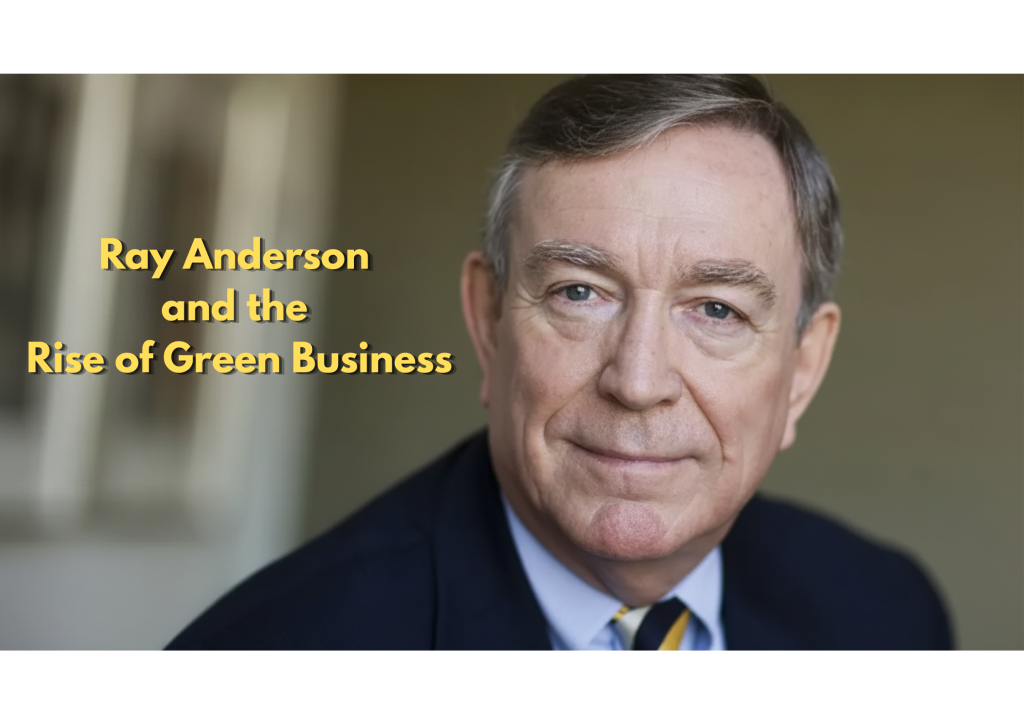
Years before sustainability was a catchphrase in the media, Ray Anderson – the man who established Interface and pioneered green businesses – was the one really pondering the question: what would it really mean to change? He had been a typical industrialist running on petroleum and driven by ambition.
Later, he changed his stripes and became one of America’s leading green entrepreneurs. He was even dubbed a “born-again environmentalist” by the world.
The Foundation
The story begins in 1934 in West Point, Georgia. Ray got a football scholarship to Georgia Tech and studied industrial engineering. In 1973, he started Interface Inc. to bring carpet tiles to America. Before that, if you damaged a spot on the carpet, you’d have to replace the whole thing. Ray saw a better way.
His company grew into a billion-dollar global leader.
However, there was a hidden price. His factories used a lot of oil and dumped chemical waste into the water. Ray didn’t see this as a problem until 1994.

Source- Interface
The “Spear in the Chest” Moment
At 60, Ray’s sales team asked, “What are we doing for the environment?” He had no answer. Then someone gave him the book “The Ecology of Commerce” by Paul Hawken.
Ray said reading it was like a “spear in the chest.” He realized he was taking resources from his grandchildren’s future and turning them into waste. He stood up before his company and said, “We are going to change everything.” He often said, “Someday, people like me will go to jail,” because he saw stealing our children’s future as a crime.
The Science Behind the Mission
Ray’s change was guided by Dr. Karl-Henrik Robèrt, a Swedish doctor who noticed more kids getting cancer. Dr. Robèrt realized kids don’t have “lifestyles”, they just live in the world we’ve created. This gave Ray’s mission a strong moral purpose.
Dr. Robèrt wrote a scientific paper about how the planet is being destroyed and sent it to 50 scientists, who criticized it heavily. He rewrote it 21 times until they all agreed on basic principles that explain how life on Earth can survive. This became the Natural Step framework.
Ray adopted four key principles to guide him:
1. Stop digging up stuff from the Earth’s crust that ends up polluting our air and water
2. Stop making toxic chemicals that nature can’t break down
3. Respect nature’s space by not destroying forests and soil
4. Use Earth’s resources to meet human needs, not just the wants of a lucky few
Mission Zero: Mount Sustainability
Ray didn’t want to just “do less harm.” He wanted to repair the damage. He pictured “Mount Sustainability,” to reach zero environmental impact. He named it Mission Zero and set the target year 2020.
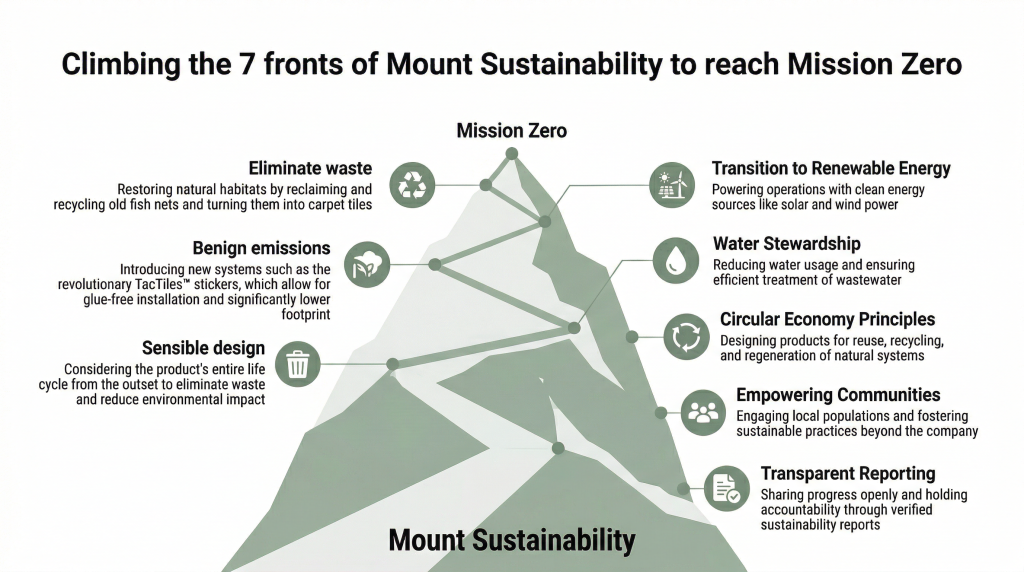
He put together an Eco-Dream Team including Paul Hawken, biomimicry expert Janine Benyus, and author Daniel Quinn. They broke the challenge down into seven areas, focusing on cutting waste, using renewable energy, and “closing the loop” by turning old carpet into new carpet forever.
The Engineering Revolution
Ray was brilliant at “whole system optimization.” He said the “status quo” keeps us stuck doing things the wrong way.
For example, he noticed that most engineers use small pipes with big motors because small pipes are cheap, but that wastes energy due to friction. He changed this to big pipes with small motors. This was simpler, cheaper, and used 93% less power. This was the kind of basic rethink Ray championed.
He also worked with a city to capture methane from a landfill and pipe it almost 10 miles to fuel his factory’s boilers. The city made $35 million, the neighborhood stopped smelling bad, and methane stayed out of the air. Ray called this “synergistic thinking,” where everyone wins.
Learning from Nature
Ray understood that nature designs better than people.
His designers studied forest floors and noticed no two leaves or plants are exactly the same, but there’s still order. They made an “Entropy” carpet where no two tiles were identical, breaking the usual industrial approach of identical copies. This led to almost no waste, faster installation, and it became their bestseller.
He also asked, “How does a gecko stick to the ceiling without glue?” His team created “Tactiles,” small sticky squares that connect carpet tiles to each other, not the floor. This removed the need for toxic glues, improved air quality, and made recycling easier.
The Math: I=P×A/T
As an engineer, Ray liked the environmental equation: Impact = Population × Affluence ÷ Technology.
He worked to switch Technology from being a source of damage to a way to reduce it. He called the old way “T1”, extracting, linear, fossil fuel powered.
He built “T2”, using renewable energy, cycling resources, focusing on how much we get out of resources, not just labor.
The Results
The results were real and dramatic:
- Waste eliminated saved $400-450 million
- Greenhouse gases dropped 82-90%
- Fossil fuel use fell 60%
- Profits doubled, and sales grew by two-thirds
Ray showed that sustainability can be great for business.
Interface reached Mission Zero in 2020. Today, they’re working on “Climate Take Back,” making carbon-negative carpet tiles. As of 2024, companies doing well on ESG metrics are about 21% more profitable than others. Ray set the gold standard.
Tomorrow’s Child
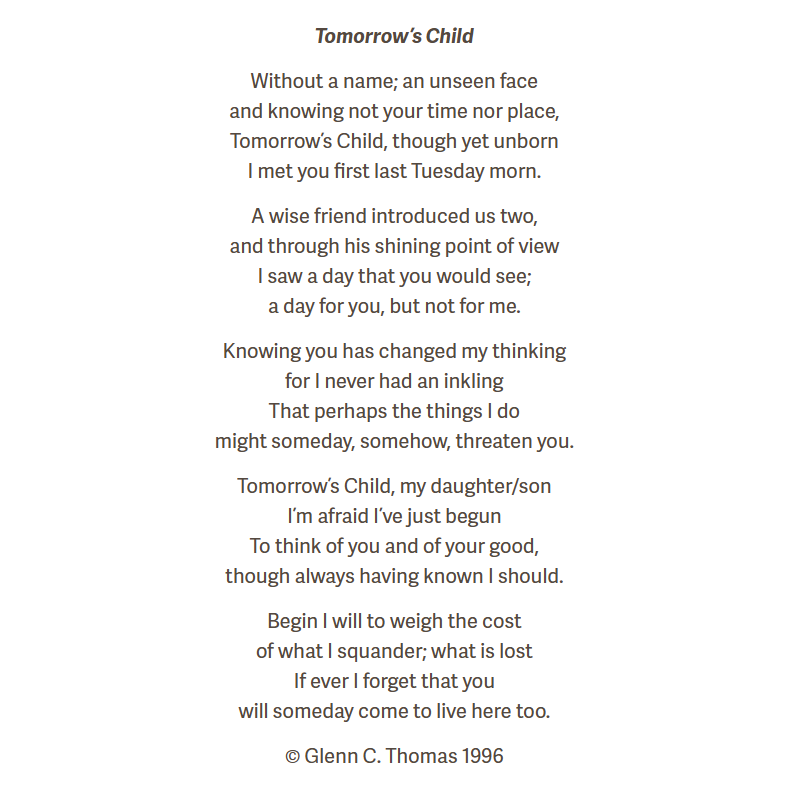
Ray often shared a poem by an employee about a child from the future asking, “What did you do? Did you care?”
Source – Ray C. Anderson Foundation
The poem says, “Knowing you has changed my thinking… I never guessed that what I do might someday threaten you.”
Ray said that the child’s voice reminded him daily that we’re all connected in the “web of life.”
Some of his quotes still resonate:
- “Unless somebody leads, nobody will. Why not us?”
- “If it exists, it must be possible.”
- “Waste is food.”
- “The status quo is an opiate.”
- “We are all part of the web of life.”
His reading list included:
1. “The Ecology of Commerce” by Paul Hawken (the book that changed him)
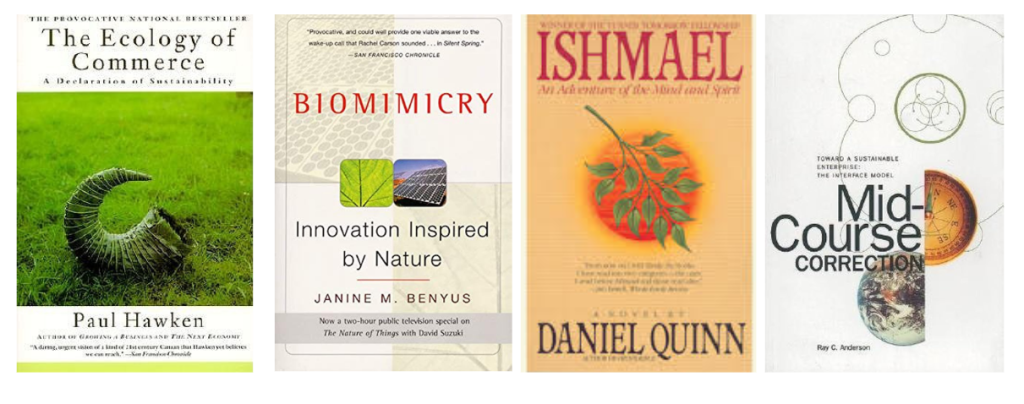
2. “Biomimicry” by Janine Benyus (inspired his designs)
3. “Ishmael” by Daniel Quinn (changed his worldview)
4. “Mid-Course Correction” by Ray Anderson (his own story)
The Legacy
Ray passed away in 2011 but left a powerful legacy. He showed that the most practical thing to do is to be ethical. A company can take nothing that can’t be replaced, add nothing that harms nature, and focus on what people really need.
In a world full of greenwashing and false promises, Ray Anderson stands tall. He didn’t just change carpet making; he changed how we think about our role on Earth. He went beyond “doing no harm” to actually making the world better.
Ray refused to steal the future. And for that, he will always be a legend.
Reference –
The Ray C. Anderson Foundation
Interface Inc. Sustainability Reports (2024)
TED: The business logic of sustainability – Ray Anderson
Ray Anderson: The business logic of sustainability
Ray Anderson – Sustainability in Action | Bioneers
Nice