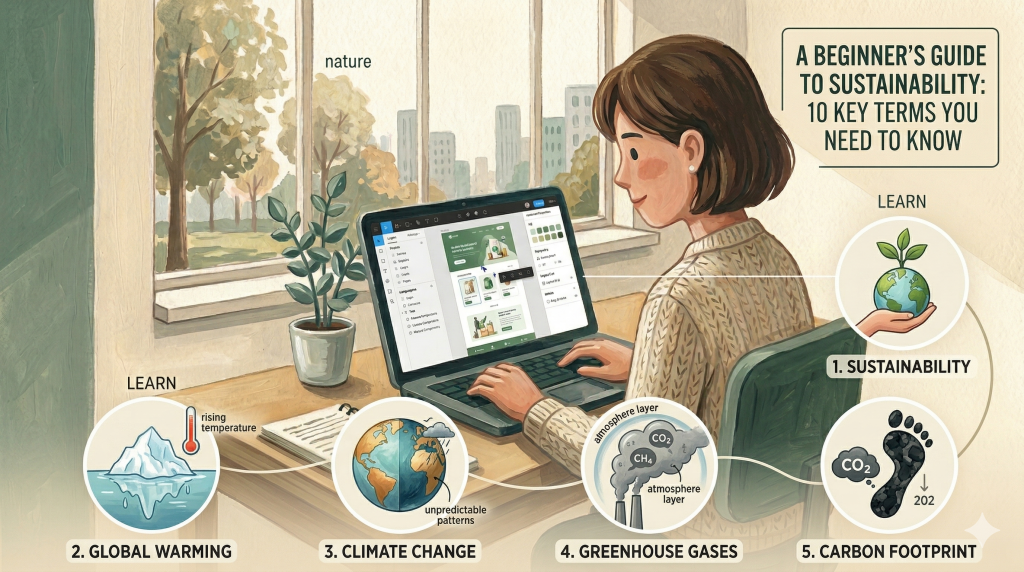
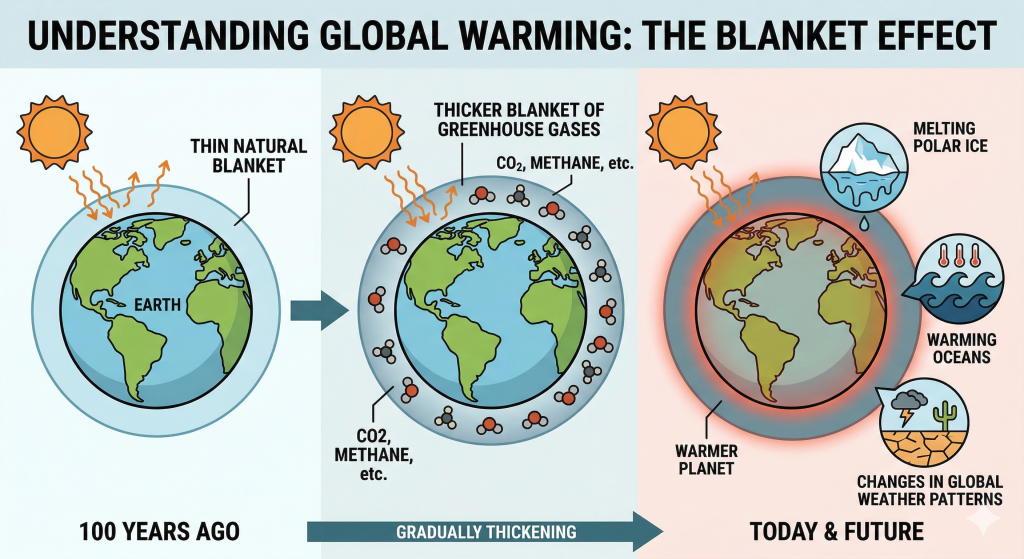
1. Global warming – It’s like Earth with a blanket on. Over the last 100 or so years, that blanket has been gradually thickening, resulting in a warmer planet. To be clear, the Earth’s overall temperature rise – not just “hey, summer feels warmer” but very much like ice at the North Pole melting, ocean waters getting warmer, quite like that. And that’s major because changes in global temperature, even at very small levels, lead to a lot of different things.
2. Greenhouse gas– In the summer, a car is heated like an oven, right? Sunlight gets in, but the glass keeps the heat from escaping; that’s exactly how the greenhouse effect works. Similarly, certain gases in our atmosphere have the same effect on Earth. They let sunlight through but trap the heat close to Earth’s surface. The most popular greenhouse gases are carbon dioxide (the gas we breathe out and is also released by cars), methane (which is produced when cattle digest food), and some others.
But these gases are not as evil as we think. But the problem is that there are currently too many of them. These gases must be below the threshold for there to be equilibrium. The average temperature on Earth would be about -18 °C (0°F) without them, as opposed to our pleasant 15°C (59°F).
The problem is the speed of the increase.
Greenhouse gas emission – The process of releasing those gases is what causes the atmosphere to retain heat. The smoke coming from a car’s tailpipe is considered an emission. When factories burn coal, that is emissions. Your fridge working or charging your phone (if the electricity is generated from burning matter) is mainly associated with emissions somewhere. In a nutshell, it is all the ways we keep pumping these gases into the atmosphere.
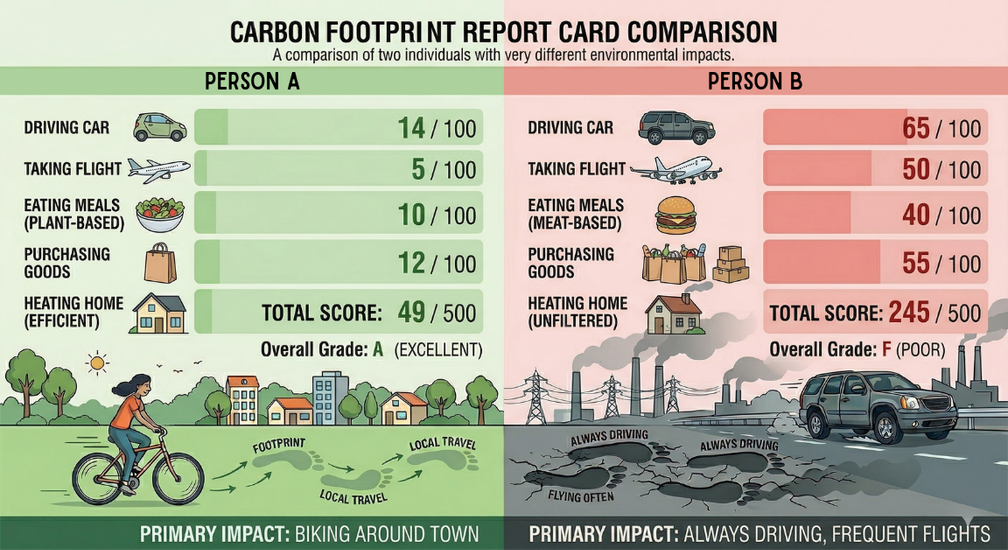
3. Carbon footprint – Imagine it as your individual pollution scorecard. Every single thing you do – traveling by car, taking a flight, eating, purchasing goods, heating your home – leads to the release of greenhouse gases at some point in the process. Your carbon footprint is the aggregate of all those small pieces of pollution that you are responsible for. If you mostly bike around town and don’t travel far, your mark is pretty light. But if you’re always driving or catching flights, you leave a heavier trail behind. The term “carbon footprint” covers all kinds of greenhouse gases, even though everyone just calls it “carbon.” It’s become the catch-all term for your environmental impact.
4. Resource exploitation – It refers to when we take things from nature, such as trees, fish, oil, minerals, etc, too quickly and without any care. Think about someone who keeps withdrawing money from your savings account without adding any back. That’s exactly what we are doing with Earth’s resources. We are cutting down entire forests without planting new trees, fishing excessively so that fish populations cannot recover, etc. It is a kind of resource usage that will not be able to last very long, which brings me to…
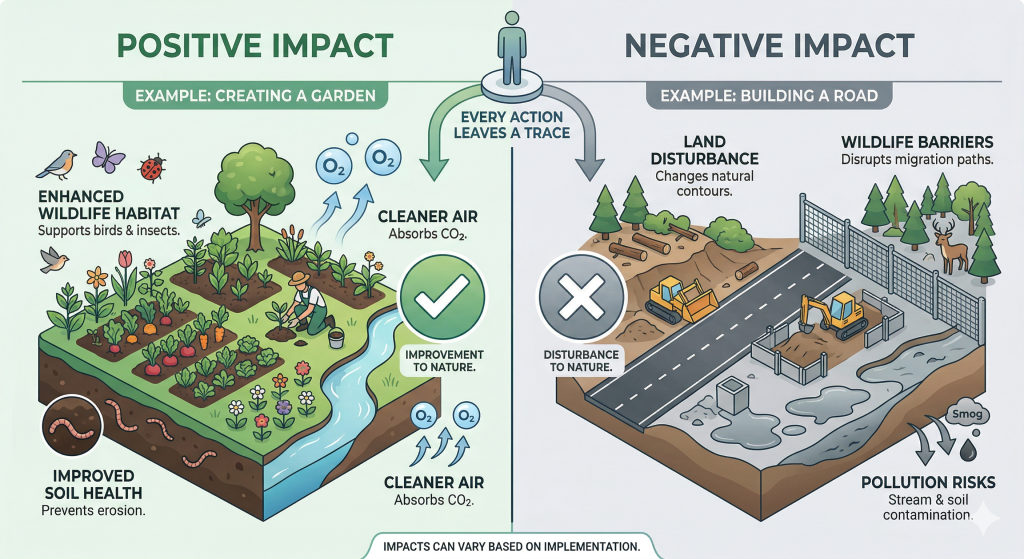
5. Environmental impact – This is simply a very elaborate way of asking “what is the effect on the environment?” We cannot do a single thing without leaving some trace on nature. An example of the impact of infrastructure development includes building a road, which will definitely change the environment by disturbing the land, wildlife, and perhaps polluting a stream during construction. The installation of a garden will also affect the environment; however, the impact of the garden is positive. There are impacts from infrastructure development, but they can be positive or negative depending on how they affect the natural environment.
6. Sustainability – Sustainability is not just about how we operate our lives today; it is also about how we can ensure that our actions do not create problems for future generations. For example, if the number of trees that you cut is the same as the number of newly planted trees, then the practice can be maintained as you can keep doing it indefinitely. On the other hand, extracting petroleum cannot be considered a sustainable practice since you will eventually exhaust the resources, and you are not producing new oil. So basically, it is a concept of not using the resources from the future to satisfy your present needs.
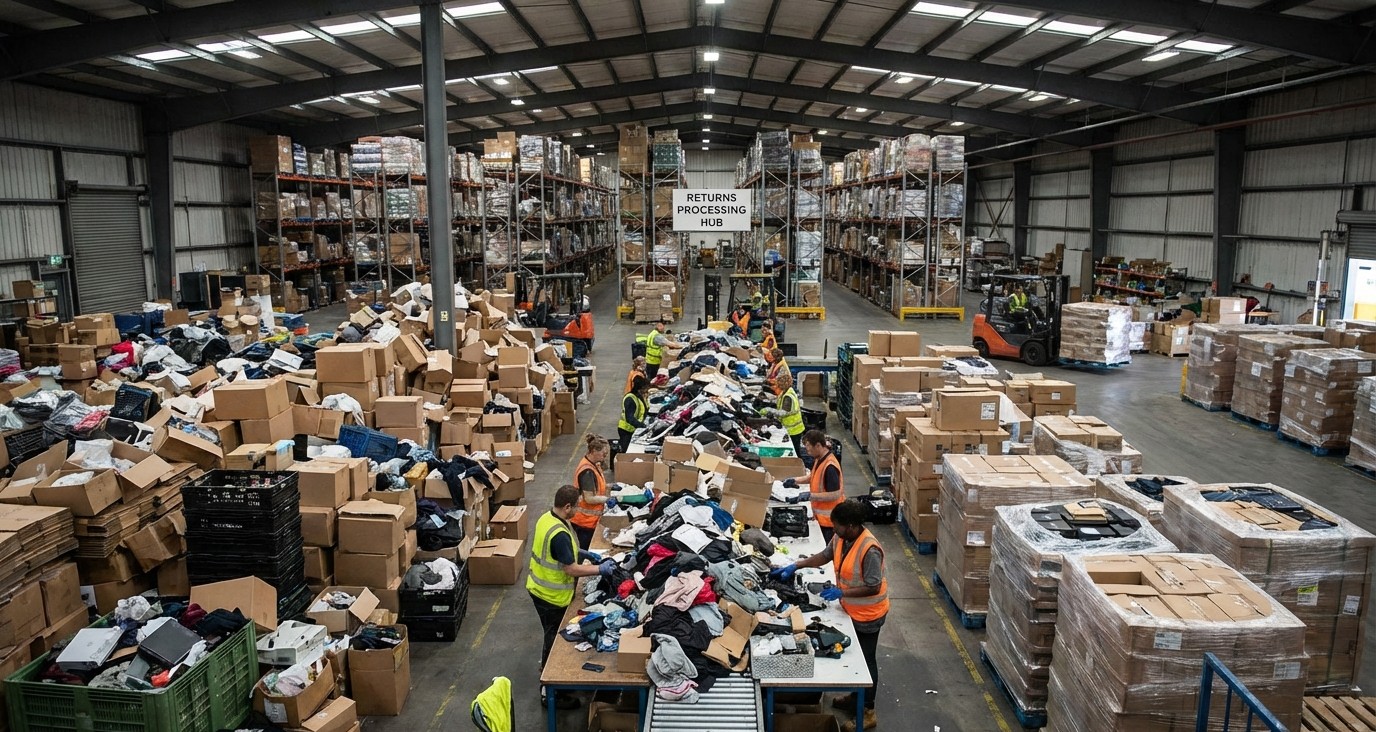
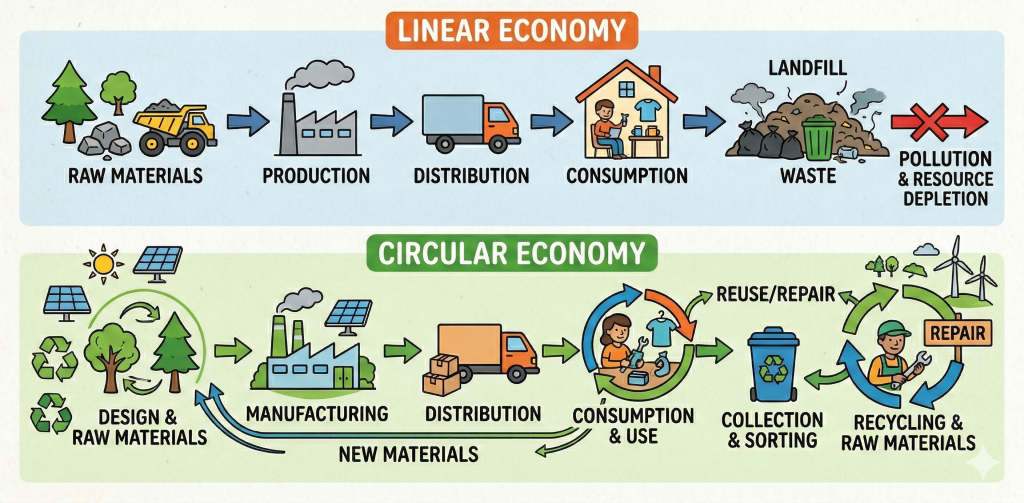
7. Linear Economy – This has been our way of living for ages: take materials, make products, and discard them. We have lived in a linear economy. You take a raw material for metal production, use that metal to make an electronic device (e.g., a smartphone), use it for a few years, and then discard it, only to mine new materials for use again in making another electronic device. The waste generated is incredibly inefficient since all this waste is ultimately disposed of in a landfill, and new raw materials will continue to be required to meet the growing demand for manufacturing new devices. If you think about it it’s like always buying new pencils half used, then throwing them away and buying more instead of just sharpening and using them.
8. Circular Economy – What happens if trash does not exist at all? Picture a loop rather than a path going one way. A device gets built, yet once its life ends, every piece lives on inside another device. Sometimes things just need fixing up so they keep working like before. A single glass bottle might just get filled again rather than broken down. The materials keep moving through the cycle. Think of leaves dropping, feeding tiny creatures, those becoming meals for winged ones, their waste helping green shoots rise. What seems finished is already starting elsewhere. Each part flows into the next without vanishing.
9. Net Zero means the overall level of Greenhouse Gases Emitted into the atmosphere should equal the amount of GHGs that are being captured from the atmosphere (or avoided), thereby giving an overall net yield of zero to those who are contributing GHG to the atmosphere through their activities. For example, your company may create some emissions, but at the same time will either plant sufficient trees to sequester C02 emissions or invest in Carbon Sequestration Equipment and Technology capable of removing CO2 from the atmosphere. At the end of the year, the total quantities of GHGs contributed to the atmosphere from both sources (removal + contribution) are equal, giving a net result of zero. It’s not flawless – you’re still polluting – however, you’re effectively negating it.
10. Life cycle assessment – It examines EVERY aspect that a product touches during its lifetime, from creation to disposal. An example is a plastic water bottle. The plastic most likely came from oil that was taken out of the ground, then processed and turned into plastic. After this, the bottle was made in a factory that used energy, then it was put into warehouses that required fuel to transport it to your store by truck. You bought the water and drank it; now the plastic bottle has been disposed of… but where does it go now?