Recycling
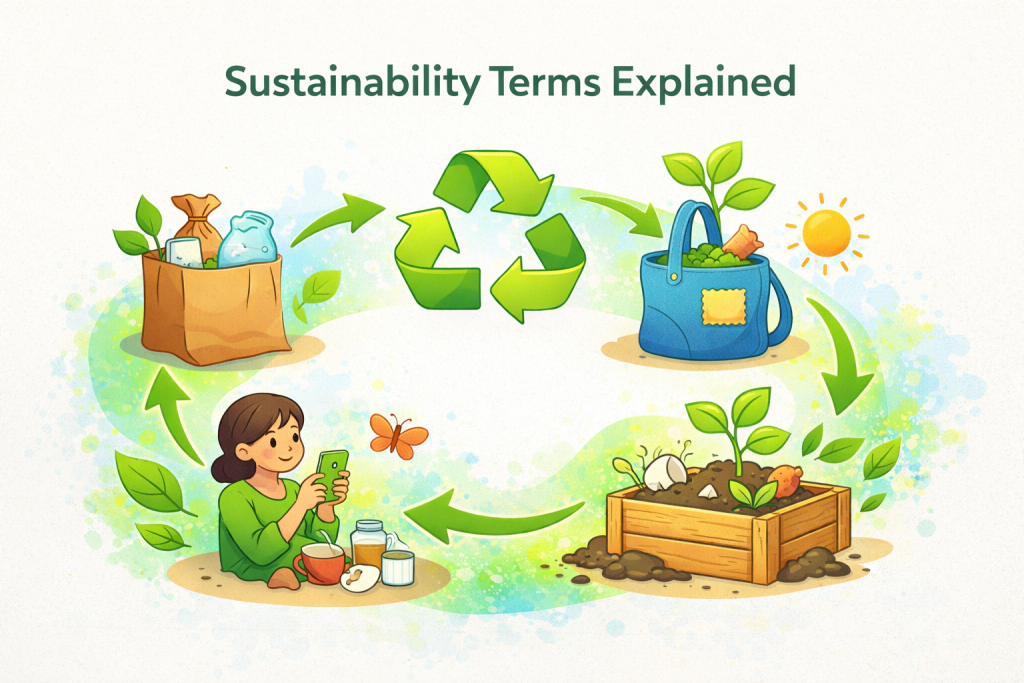
Recycling is a way that you can use an item or a material multiple times within the production cycle. A newspaper is an instance that is commonly recycled. You gather a newspaper, which is rubbish, it is broken down into material, and finally it is made into a completely new sheet of paper. With the help of this method, you can make new products by using fewer of the world’s natural resources. Recycling is the reprocessing of post-consumer materials (e. g., paper, plastics, and glass) into new products.
Downcycling
What do you do if the value of the material decreases when it is reprocessed?
Downcycling means recovering material, turning it into a product that is less useful than the original one, in the case when an element to be reused is of lower quality. Changing the form of the material to the point of weakening or loss of function is one of the reasons why quality decreases. For example, plastic containers after their reprocessing, being turned into items such as roadside barriers rather than new packaging, outerwear, and refuse bags, are the most common types of downcycled plastics. Purity decreases through each cycle, without appreciable changes in the market situation, limiting the possible future uses. A lower grade means less suitability for previous roles due to the structural weakening.
Upcycling
Upcycling means taking old or unwanted products and turning them into new things that are more valuable, functional, or attractive. A friend of mine uses old T-shirts to make tote bags by simply cutting them. Besides that, it is common that a wine bottle is recycled by turning it into a decorative pot or planter. One doesn’t necessarily have to melt down or destroy an original item; rather, use your ingenuity to give old products a fresh new look.
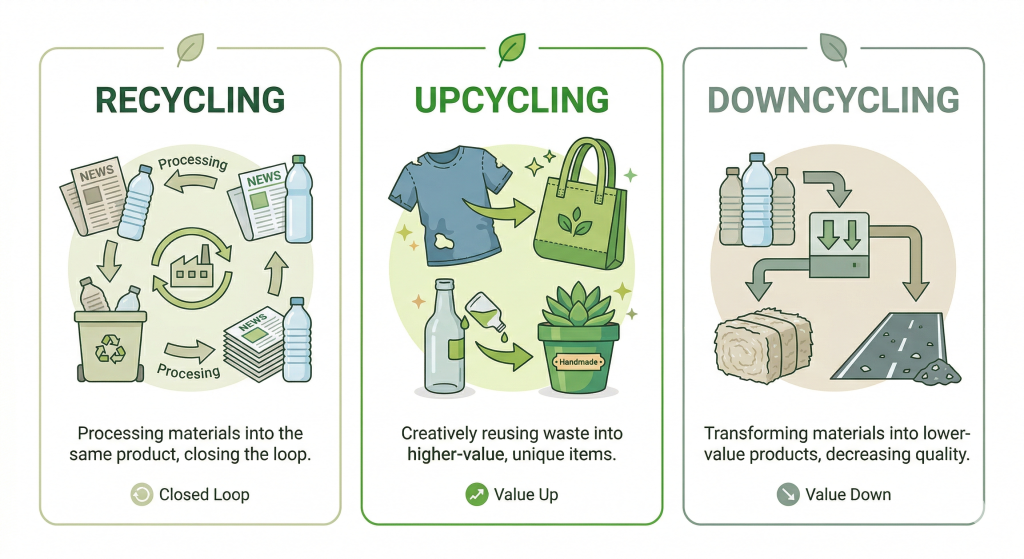
Difference between Recycling, Downcycling, and Upcycling
| Concept | What It Means | Process | Outcome | Example | Key Insight |
| Recycling | Breaking down old materials to create new products of similar use | Materials are crushed, melted, or processed into raw form | New product of similar value or function | Plastic bottles turned into new bottles | Requires energy and industrial processing |
| Downcycling | Recycling where the new product is lower in quality | Materials are processed but lose strength or quality over time | The product becomes less useful or non-recyclable later | Fabric → insulation, plastic → decking | Delays waste, but doesn’t eliminate it |
| Upcycling | Reusing items creatively without destroying them | No heavy processing, just redesign and repurpose | The product becomes equal to or higher in value | Jar → lamp, old jeans → tote bag | Creativity replaces industrial recycling |
Biodegradable
Biodegradability is the term used to indicate how capable different types of materials are of being decomposed by living organisms (bacteria, insects, etc.) after some time. This disappearance of the material is part of a natural cycle where microbes act to break down a substance. For instance, the remains of an apple are gradually devoured by microbes so that they ultimately disappear completely. On the other hand, plastic bags are not subject to the natural process of decomposition; as a result, they can take hundreds of years to break down, even in conditions similar to those required for apple cores.
Composting
Composting is a natural process that can be used for reusing the items that people normally throw away, such as fruit and vegetable waste, as well as yard waste (leaves and grass clippings). When these organic wastes are decomposed in a controlled environment, the final product or compost is a dark, nutrient-rich, soil-like substance that is great for growing plants. A “nutrient” is a substance that supplies nourishment to other living organisms.
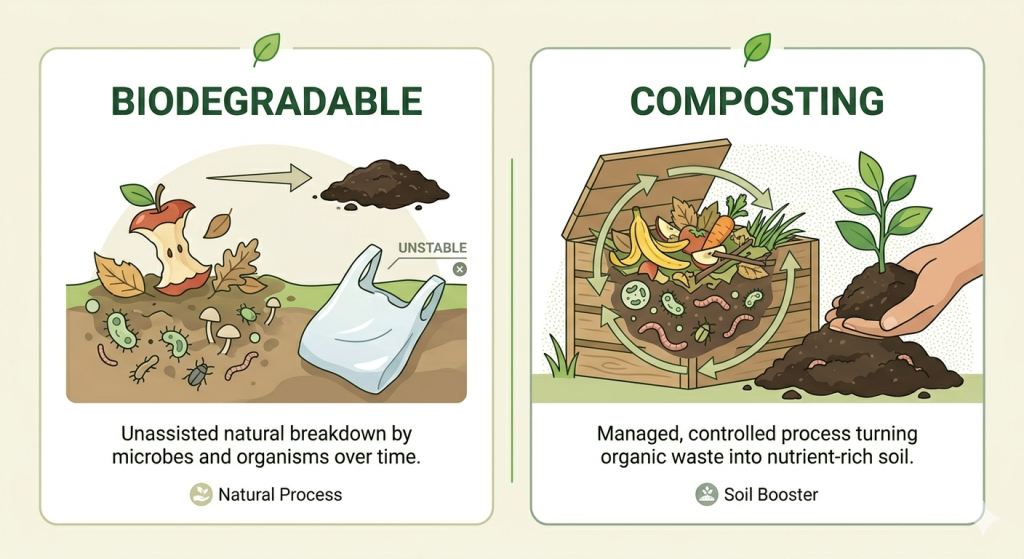
Difference Between Biodegradable and Composting
| Concept | Definition | How It Works | Process Type | Outcome | Important Notes |
| Biodegradable | The ability to naturally break down over time | Microorganisms like bacteria and fungi decompose the material | Natural (no human intervention required) | Breaks into basic natural elements (e.g., soil components) | Not all biodegradable items break down quickly or safely in all environments |
| Composting | Controlled breakdown of organic waste into nutrient-rich soil | Organic matter decomposes under specific conditions (air, moisture, microbes) | Natural but managed process | Produces compost that enriches soil and supports plant growth | Not all biodegradable items are suitable for home compost (e.g., meat can cause issues) |
Zero Waste
Zero-waste living means producing the least amount of trash possible. In an ideal situation, none of the waste will get to the landfills – places where societies bury their discarded items. First of all, one should avoid, by way of rejecting the unnecessary things people often get used to, accept less stuff. Next, buy less, which limits the things entering the house. Existing things, getting more and more used, ones that are very close to being worn out, are yet another chance, ones over and over again by use. When a product is no longer of use and can be recycled, the recycling system takes care of the appropriate elements. Organic waste goes a completely different way: it is naturally decomposed into a soil enrichment. Unpacked products greatly contribute to this process. Also, bringing your own durable containers when shopping is a good idea. Leftover food? They definitely go into the compost pit.