
What began as a gradual change has now become evident. In the past, our planet had so much to offer humans, but one day, there were no longer limitless options available to us.
Over the span of many years, we have watched the depletion of resources occur very subtly and have only been made aware of this issue through some very high-profile events such as droughts across the world, shortages of food and/or water in many areas, and increasing prices of basic necessities.
No one knew how long this was going to take; there are still no clear indications of the timeframe. The methods in which we utilize our planet are a result of circumstantial necessity rather than our own pre-conceived notions of how things should be done.
This article covers the timeline and the real need to bring sustainability into our businesses and daily routines.
A look back
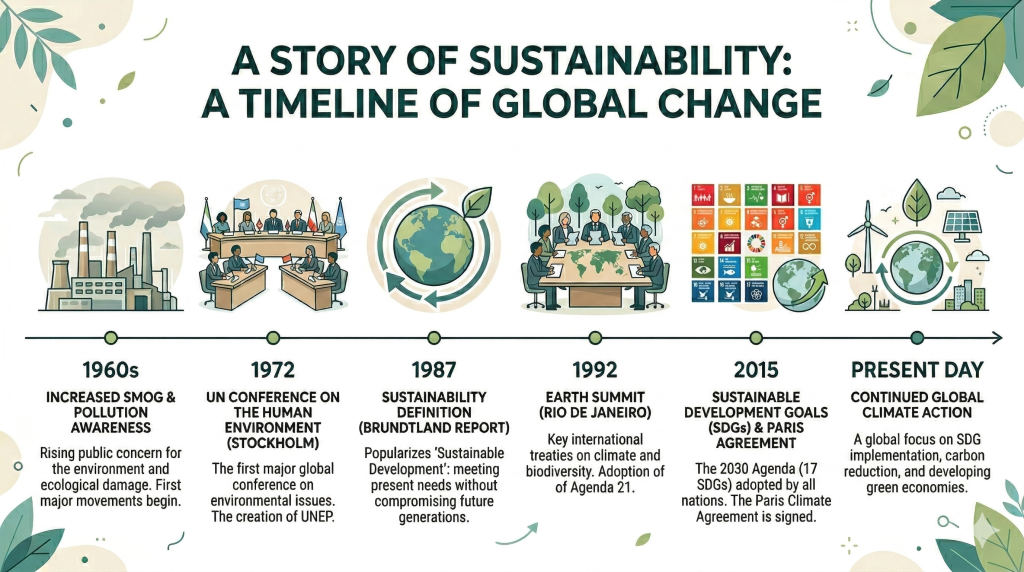
1960s
The first alarm bells
Out of nowhere, city skies grew heavy with smoke. Rivers ignited – yes, caught fire – from factory runoff seeping into waterways. Animals vanished without a trace. Then came a quiet shift: citizens paused, eyes narrowing at the horizon, wondering aloud how far things had gone.
1972
Meeting one another globally, it happens now for the initial moment
Beginning in 1972, the United Nations gathered world representatives in Stockholm for its initial large-scale meeting on environmental issues. Together, nations acknowledged that ecological challenges cross borders, requiring cooperation rather than isolated efforts.
1987
Sustainability receives a meaning
That 1987 UN Brundtland Commission document gave us a definition still quoted widely – “satisfying current demands while preserving future generations’ chances to satisfy theirs.” Plain words. Yet they shifted perspectives on progress overnight. Though brief, the idea altered long-held assumptions about development forever.
1992
The Earth Summit
More than 170 nations met in Rio de Janeiro. Because of rising environmental threats, talks covered climate shifts, loss of species, and forest decline. When scientists’ warnings reached world leaders, a new phase began. From that point forward, care for Earth became part of the international debate.
1997
Kyoto Protocol
Countries promise cuts in emissions – on paper alone
Starting in 1997, the Kyoto Protocol became the initial global treaty requiring countries to reduce heat-trapping emissions through fixed goals for industrialized nations. Although designed with good intentions, its impact weakened when America declined to join, while fast-growing emitter China faced no required cuts. Despite shortcomings, one clear message emerged: releasing pollutants into the air could no longer be free.
2000s
Businesses take notice
When storms intensified and supplies climbed in cost, firms began seeing eco-practices not only as right but practical. Cutting excess became a way to lower expenses. Choosing sustainable options pulled in buyers. Later, profit and planet started aligning in new ways.
2015
A Global Roadmap Called The SDGs
Backed by global consensus, 17 targets emerged under UN guidance, ranging from fair wages to cleaner power sources. With deadlines set for 2030, nations, companies, or everyday people now align efforts through this common framework.
The world’s ambitious agreement on climate change – The Paris Agreement
In December 2015, nearly 200 countries came together in Paris to sign a shared pledge to limit global warming to a maximum of 1.5°C above pre-industrial levels. Unlike earlier efforts that stalled, this deal succeeded where others failed by bringing together rich and poor nations under a single framework. While flaws exist within its structure, the moment marked something new: every nation aligned on reducing emissions. What stands out is not perfection but unity, a collective step forward shaped by compromise.
Today
Now it falls to each person alike
Now part of daily life, sustainability shows up not in speeches but in small acts – how people buy, travel, toss things away. This change sticks around because there is no real alternative anymore.
Why it matters now
Not everything on the planet lasts forever. Soil weakens when stressed beyond recovery. Water disappears faster than it returns. Clean air thins under constant pressure. Even temperature balance shifts when disrupted for too long.
Starting fresh doesn’t mean giving things up. Choosing paths that last changes how we see progress, ensuring Earth remains livable down the road.
Change in how goods move matters for companies, along with lowering pollution while being open about operations. People might just reduce spoiled meals, choose nearby stores, or replace outdated devices with efficient models instead.
Now that awareness has grown, the past decades show a gradual shift in mindset. Today, denial isn’t holding back progress. Movement itself becomes the measure of our response.
Great !!!!